Issues relating to my locality
Swedish maternity care
Maternity care in Sweden is currently having a crisis at several levels. It is worse in certain aspects in certain regions. I thought of looking at postpartum depression in Sweden and maybe in particular in the region where I live. I personally know more women that have had a post partum depression after giving birth, than not. But the majority of the people I know that has suffered from it has made it without any help and coping by themselves has cost them months and in some cases years of not feeling ok, not being present, not being able to be the mother they wanted or being able etc. I do feel however, as if this is too much to take into a school project for a few weeks–women who live like this deserve more than that. There is also a national problem with women rupturing badly when giving birth. Sweden uses a scale between 1-4 for measuring ruptures due to child birth, where grade 3-4 are considered serious with long term consequences: https://www.svt.se/nyheter/inrikes/stora-skillnader-i-risken-for-allvarlig-bristning-vid-forlossning This differs hugely between different regions in Sweden. One problem and a debate surrounding this matter is that women have to fight for the right care, and many women are unable to live functional lives because of it, but it is considered a “natural” consequence of a natural thing–giving birth. Hospitals does not always report the ruptures in their full scale as it reflects badly on their statistics. This recent published article reveals a range of disturbing statistics around Swedish maternal care, showing that some women and many children have died due to the hospital being understaffed, lack of care or other reasons. This is an interesting, urgent and important issue, but maybe also a bit too tense for a school project.
Rural vs Urban areas, class divide & environmental impact
I thought of circular living and economy. And how where I live in the little village of Tvärskog, people are quite resourceful. Looking from a socio economical perspective the people out here live resourceful simple lives. Meaning that many live a more sustainable lifestyle than the more urban people do.
First I considered looking into a service design that can enable a more resourceful living, and help more people to live a more circular lifestyle. The problem is though, I don’t really believe any environmental change is going to happen… And I do not really believe in that sort of lecturing, usually the lecturing ends up in the hands of the upper middle class who loves lecturing the working class on how to live, behave, consume etc. While the statistics clearly show that it is the upper middle class and the rich that is responsible for our environmental downfall. I think we are basically doomed and the wealthy is to blame. It is not the working class that is the problem or polluting the world, it is the wealthy.
Swedes’ consumption emissions are among the highest in the world and the carbon dioxide emissions are also unequally distributed within the country. The richest 10 percent of Swedes have a carbon footprint that is 8 times higher than they need to be until 2030 for the world to have the 1.5-degree target within reach. 88% of the Swede’s live in an urban area. The class divide between rural and urban areas are increasing in Sweden: https://www.dagensarena.se/innehall/klassklyftan-mellan-stad-och-land-vaxer/
Tvärskog
Average income in Tvärskog: 17 519 SEK /mån (considered low income)
Post secondary education, total 33%.
Background
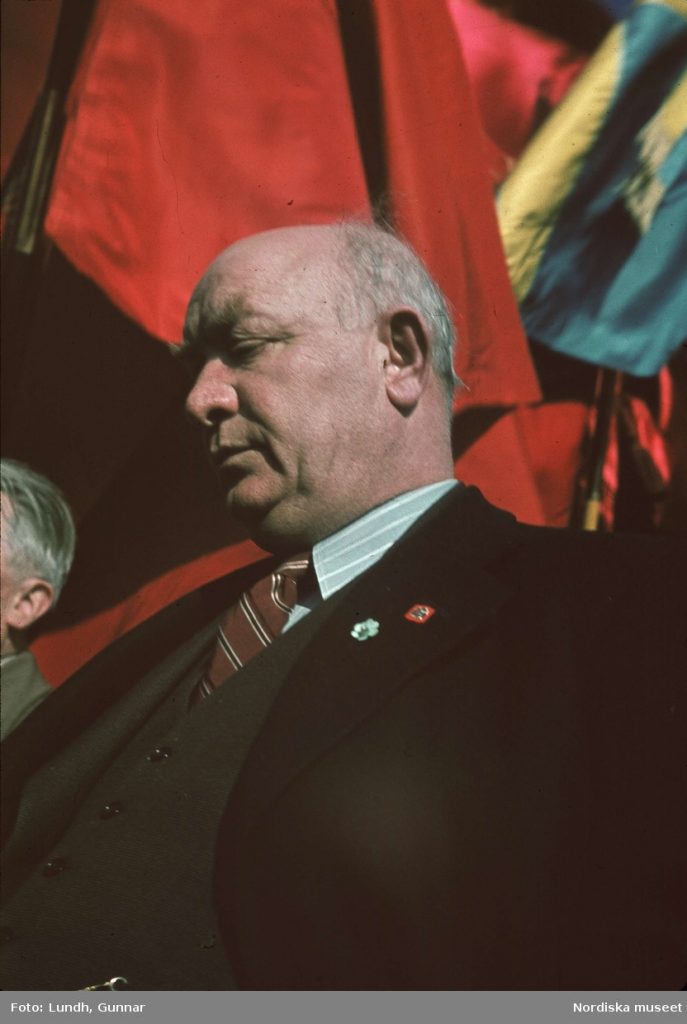
»The Peoples Home«
Sweden has historically had a robust social democratic welfare model that has affected our economy but also our self-image. During the 1980’s a turning point in societal development in terms of equality occured and income disparities in Sweden started increasing. It was mainly the capital income that was increasing, while the tax policy did not have the same leveling effect as before (Heuman 2019). Göran Therborn states that this change »split society between capitalists and ordinary people« Between 1983 and 1997, the wealth of the richest hundredth increased by 81 percent and decreased for the poorest 40 percent of the population by 129 percent.
Between 1991 and 2016, incomes from work and entrepreneurship increased by over sixty percent, while income from capital grew by 229 percent. The societal split Therborn talks about, was further increased by abolishing wealth tax, inheritance and gift tax and property tax, but also by the lowering of taxes on capital income to the point where they were lower than on (higher) earned income. Therborn means that this development introduced corruption on a new level in Sweden, where members of parliament stole extra money from the Swedish taxpayers. (Heuman 2019)
In practicality, in contemporary Sweden, this means that the richest hundredth has a disposable income, that after taxes and transfers, measures up to about ten times greater than that of the median income earners in Sweden.
Class divide in relation to environmental impact
At the same time, while the gap between the upper class and middle class Swede is widening sharply. There is an acute climate crisis, in which Sweden plays a role where these gaps are further intensified.
The middle and lower class groups have reduced their environmental impact since 1990, the 10 percent of the richest Swedes have barely contributed at all to the reduction in emissions. These percent are responsible for 24 percent of the cumulative emissions in Sweden, that is more than twice as much as their proportionate share.
The richest 10 percent need to reduce their emissions from 17 tons per person by 87 percent, in less than a decade to reach the 2030 goal. (Oxfam 2020)
Considering the 10 richest previous contributions in reducing Sweden’s emissions, this will likely not happen. What will happen then?
Therborn states that »the system must be shaken to open a path towards change.« (Heuman 2019)
Aniara
Aniara is a monumental piece in Swedish literature, Harry Martinsson wrote it in 1956. After it was published he won the Nobel prize. It is a book, epic / poem. Just last week I talked about how impossible it would be to translate the feeling of Aniara to someone who is not a Swede, since there is an atmosphere and a way of the language that is so Swedish. I personally think that Swedishness is only capture in few cultural expressions from Sweden. In some of Roy Andersson’s films for example. It is this feeling of being almost ill at ease through the portrayal of people being distant, things going slow. Hard to explain.
Harry Martinsson began writing Aniara in 1953 as the Soviet Union did their first Nuclear bombing. Aniara is a metaphorical existential look at the individual and humanity. Why humanity use all that knowledge only to harm ourselves and our habitat, the earth.
The wording and language in this book is spectacular. It is about Aniara, a space shuttle transporting 8000 people at the time, from the earth to colonised planets Mars and Venus. Earth is destroyed by environmental destruction, pollution and nuclear war. During one of these journeys between earth and the colonies, Aniara gets hit by an asteroid and drifts with unimpaired speed off away from the solar system. This becomes an inconceivable reality for the passengers and crew of the ship that is slowly drifting into nothingness, year after year as “a little bubble in the glass of Godhead.” The humans on the ship are small and meaningless outside the premises of their constructed perception of their world.
Hell as a retreat
I recently read an article where a few women had a conversation over email after having seen the Swedish film adaption of Aniara (2019) and one of them, Ann Ighe, wrote such an amazing and spot on analysis of Aniara:
“Quiet apocalypse. That’s what I think after watching the movie Aniara. There is something in the dignity and slowness of the doom that Harry Martinson wrote out with Aniara, which is picked up very nicely by Pella Kågerman’s and Hugo Lilja’s film.”
“I feel that my heart is so much more filled with horror by the quiet apocalypse. For me, Aniara is about that, among other things. It is about when time passes and everything just gets more and more quiet. Hell as a retreat.” (Ighe 2019)
Idea
I am thinking of making a booking system for Aniara. The world is about to end, you will either stay back or go for hope for future on Aniara, but without knowing that its devastating faith is worse.
I want to tie this to environmental issues and class. I want to use the book Imperial mode of living, as inspiration. A conclusion from that book can be that it is not the poor that is the problem, it’s the rich. Instead of eliminating poverty–we should eliminate wealth. I would also like to use The Future of Urban Consumption report as a foundation for the booking process and to create a traveller’s profile that will define how the consumers living standard on the ship will be. You will fill in how much emission you are responsible for letting out through six categories. And the sum of that generates a travel profile, based on the consumers wealth status and environmental impact. The more harm you have inflicted–the higher the profile, and you might be congratulated with traveling in the “Sarcophagus Suite”. There is a lot to pick up on from the wording of Aniara to give glimpses of what is going to happen to the people on that ship. They are being sent away to an eternity of hopelessness. Hell as a retreat.
I am trying to use service design to underscore that wealth is what needs to be eliminated to be able to start working towards change. I am doing it by creating a booking system for literally removing the wealthy from earth using the Swedish ship Aniara. The wealthy believe that they will leave the poor to burn with the earth they destroyed, while they enjoy their retreat on the ship on their way to the colonies.
Further development of idea
Aniara
Harry Martinson was one of Sweden’s most known proletarian writers and the book Aniara is a distinct work of his that earned him a Nobel prize. Aniara is a poem about leaving a destroyed earth behind and moving towards a new future on Mars, but some time into the flight Aniara avoids getting hit by an asteroid, takes a sharp turn and begins an eternal drift into nothingness. The passengers must handle the fear of a fate they can not affect and conform to a new kind of life. A fate that can relate to the one we are currently facing with the climate crisis.
A critical design idea
This idea had the intention of having a critical perspective, where the focus was on the issue of the increasing class divide in Sweden and how the 10 percent of the richest Swedes are to a big extent responsible for Sweden’s emissions. I was, however, interested in creating a lens into these problems that contained some complexity and not only construct a relationship of good vs. evil.
»Critique is not necessarily negative; it can also be a gentle refusal, a turning away from what exists, a longing, wishful thinking, a desire, and even a dream. Critical designs are testimonials to what could be, but at the same time, they offer alternatives that highlight weaknesses within existing normality.« (Dunne and Raby 2013)
Approach
Aniara would be an exaggerated echo of the Swedish state under the shift in Sweden during the 80’s. The ambition was to explore what happens when that system is put in relation to a user that benefited by the shift and was to some extent unaffected by the regulatory parts of the state. Could that relationship reveal the differences between our feelings toward the marginalised and people living in excess?
This project was not aiming to challenge or make change, but rather present an opportunity for reflection. It could possibly serve as an increase of consciousness of class in Sweden, something that Therborn claims has decreased. (Heuman 2019).
»The imperial mode of living is, in our view, a major reason for the problems in implementing structural changes. It is deeply embedded in political institutions, the economy, culture and mentalities; in the ways in which people see themselves in the world; in the interests of relevant political and social actors; and in the practices of everyday.« (Brand and Wissen 2021)
During a group crit Elise Robinson said that she liked the fact that the idea was basically selling someone their fate on Aniara. This comment catalysed the idea into a state of reflection on what kind of fate that actually was.
As the presented image on that crit was of a ticket someone commented that the idea could possibly start at that ticket and direct the user into their confinement on Aniara.
Brief & visualisation

Problem
Sweden was once a social democratic welfare state. However, after the 80’s Sweden turned into the European country with the fastest growing class gaps and the most privatized welfare state. This shift has condemned the people of Sweden to different living standards and life expectancies. While the wealthy get increasingly wealthier and are to blame for a big part of Sweden’s emissions that they barely contribute to reducing.
User
Wealthy Swedes, 35-50 years old (born 1960s-1980s) with a focus on the heirs of the top families: Rausing, Schörling, Wallenberg, Stenbeck, etc.
Purpose
Increase consciousness of class in Sweden and initiate a discussion, reflection or feeling towards the contrast of imagining the extremely wealthy operating in an exaggerated echo of Sweden’s social democratic welfare state.
Solution
An idea set in a world where climate crisis consumed the earth. The only way for survival is on a space station. The user will be faced with an in-flight service echoing a Swedish state regulated system through an AI run interface based on the premise that instead of eradicating poverty—
eradicate wealth.
This premise takes form in the system’s regulating service that is depending on the user’s mode of living on earth. A user who lived a wealthy life in excess on earth will have a more regulated subsistence on the space station.
Tools
- Archetype
- User emotional journey
- Service package
- Tomorrow narratives
Why a speculative concept?
Hunt (2017) discusses how the role of the temporal in design can lead to questioning cultural orthodoxies, rather than trying to solve problems. He quotes Marcus and Fisher »The challenge of serious cultural criticism is to bring the insights gained on the periphery back to the center to raise havoc with our settled ways of thinking« (Marcus and Fischer 1986: cited in Hunt 2017).
He discusses a speculative mode of inquiry, where the designer can invent speculative future concepts to make visible what is emerging in our present.
»These projects envision design futures through the technique of scenarios. They stretch our current conditions to their logical extreme, extrapolating the present into the future. Like science fiction, these scenarios of a designed future foreground the politics of our current manias. In that way, they implicitly challenge our designed–and social and political–orthodoxies.« (Hunt 2017)
Could the project take aim towards a speculative service design in a future where we all have to abandon the planet and live under an AI in flight interface on a space station. The core service could serve as a commentary in itself, requiring the user to adapt to a solidary mode of living. The service would be based on the notion that the communal is the only way of continued existence. »No common is possible unless we refuse to base our life, our reproduction on the suffering of others, unless we refuse to see ourselves as separate from them.« (Silvia Federici cited in Brand and Wissen 2021)
Finding the Swedishness
The idea would explore a tone of voice that was present during the previously mentioned robust social democratic state. A tone of voice that can be interpreted as dry on the verge of crass.
To better navigate and communicate that tone of voice, a shorter analysis was conducted of how that has been expressed in Swedish context.
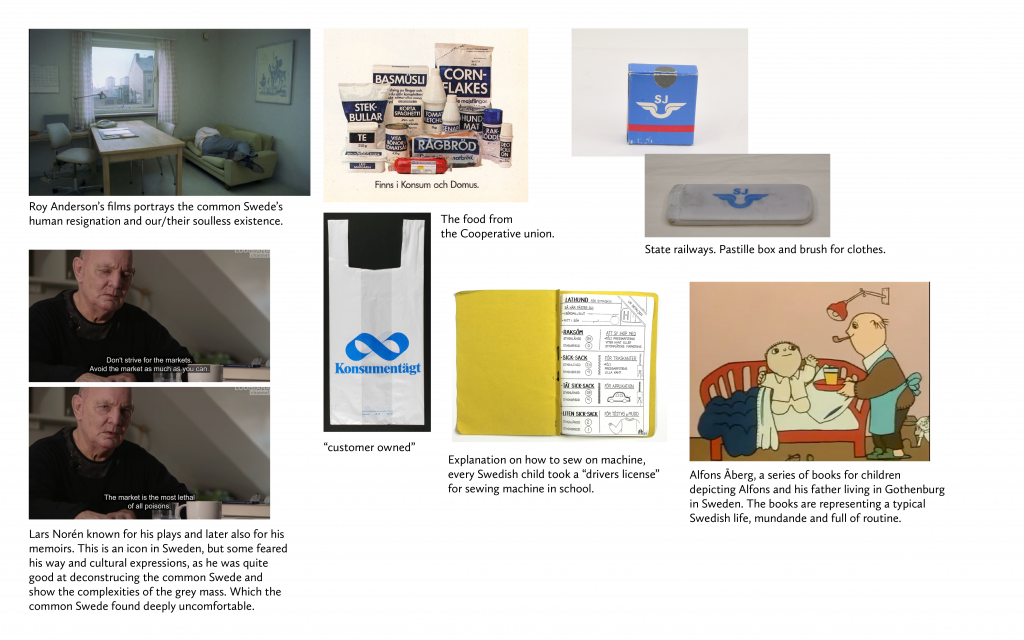
Despite having pointed out the upper class as my main user previously, I am intrigued by the upper middle class in Sweden. A much bigger group, lots of influence and people that might better relate to the sort of language I am using.
A quote from Roy Andersson about the middle class: “They always wants a little bit more than they can succeed at and therefore look at their failures with greater bitterness than the working class and the upper class.”
Resources
Clarke, A., (ed) (2017) ‘Chapter 6: Prototyping the Social: Temporary and Speculative Futures at the Intersection of Design and Culture’ in Design Anthropology: Object Cultures in Transition, London: Bloomsbury, pp. 87 – 98.
http://www.tidskriftenordobild.se/ordoblogg/category/helvetet-som-retreat
https://www.forskning.se/2021/10/06/rik-eller-medelklass-fem-satt-du-kan-gora-skillnad-for-klimatet/
https://karta.kalmar.se/filer/dokument/op/Ortsanalys_Tv%C3%A4rskog.pdf
https://www.etc.se/debatt/lyft-klassanalysen-i-klimatdebatten