Lecture, reflection

A thought that came to mind taking part of Patrick Thomas project was how easily you have the power to construct truths with graphic design as a tool. Understanding and using semiotics and symbolism when constructing narratives or forming messages is an incredible platform for directing the receiver’s perception. Can be used for both “good” and “bad”. As discourse pushes forward we learn to uncover attempts of sending out misleading information and concepts as “greenwashing” take form for example.
Reflections on lecture by Martin Hosken
“Images carry meaning that is dependent on context and this meaning can change.” Hearing Martin Hosken say that and reflecting on how semiotics can inform a message, got me thinking about a photographic exhibition and a book a few years back. Purity by David Magnusson, “During a Purity Ball young girls promise to “live pure lives before God” and to remain virgins until marriage. In return, their fathers sign a commitment promising to protect their daughters’ chastity. Sometimes rings are exchanged as a symbol of their vows. David Magnusson has photographed and interviewed young girls and their fathers who have participated in Purity Balls in Louisiana, Colorado and Arizona.“

Attending his exhibition and the speech he held at it made me realise the function of semiotics in work. Presenting this exhibition in Sweden caused for some debate. The photographer told a story, causing me to further understand how the outer context inflicts the connotation of the signs in the photograph. When this exhibition was in Houston, the curator had said upon seeing the photos, something like “Oh that’s my friend there!” Recognizing a person on one of the photos, I think even attending the same church as them. So the inner context remains the same, but its meaning is dependent on the outer context. What would happen if the sender was not a photographer making a book and exhibition, but was instead for example an American Christian magazine? Or a Swedish Feminist magazine?
This image reinforces a myth as brought up by David Crow (2016:66), in this photograph it is a myth of the woman as either pure or not. The old false dichotomy of the madonna and the whore complex. Houston possibly had the cultural context whereas that myth was part of the interpretation. Yet in the context where I was, seeing this exhibition, the interpretation was rather a misogynist one.
Gillian Rose writes:
“Myth makes us forget that things were and are made; instead, it naturalises the way things are. Myth is thus a form of ideology.”
(Rose 2016:131)
For me, having an interest in analyzing power structures, and drawing a lot of inspiration from history, it is important to understand and be able to unpack these myths. As they often derive from obsolete and harmful values, yet presented in contemporary clothing, with good intention. That is why it is so important to have that extra perspective. Finding ways of bridging history and graphic design, but at the same time being able to position that in a context of anthropology. To get a better understanding of what lies beneath. There is a responsibility to be taken in graphic design, and in history. Historians love gate keeping their knowledge behind bars of rigid precision in time and place, but that is also a way to maintain old power structures. Being a graphic designer however, pushing the edges of perception, provides the opportunity to deconstruct this precision. To bring old architectures of historical narratives into the bright light of anthropology, at the frontier of discourse, and unpack the myths.
This is the reason a paradigm shift, like an anachronism, can be such a powerful political commentary with small means. As it does exactly that, deconstructs the past and lay bare the mythological level at the edge of our contemporary discourse.
Research & analysis
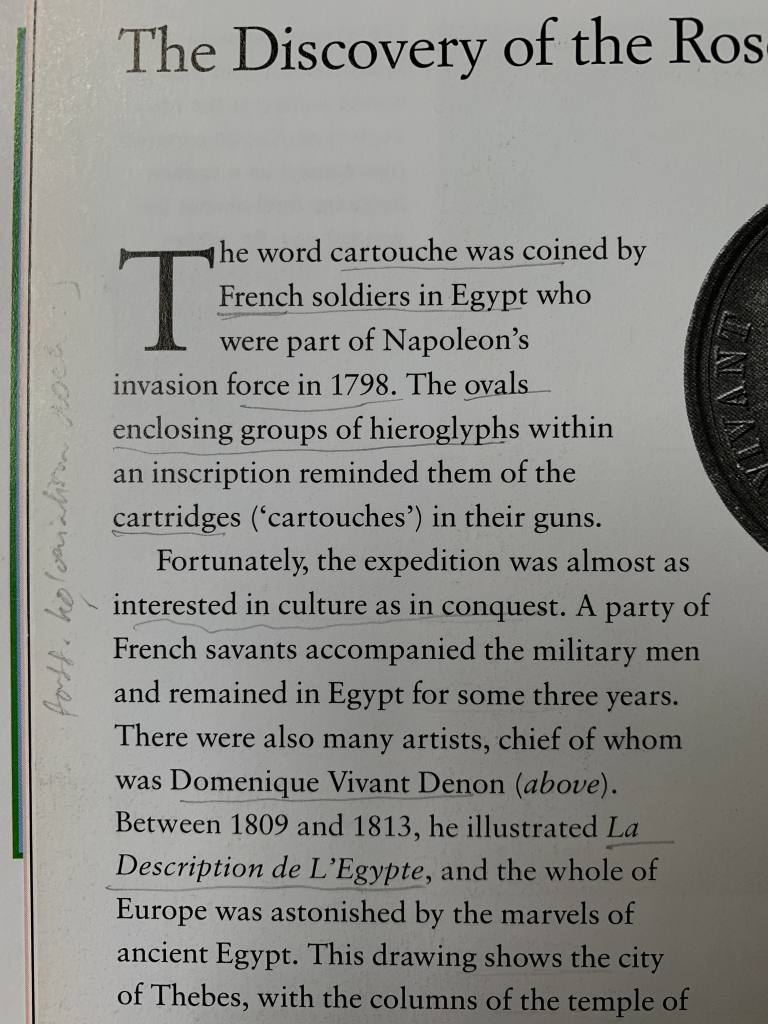
In my edition of The Story of Writing by Andrew Robinson there is this sentence saying “Fortunately, the expedition was almost as interested in culture as in conquest” I remember reading that for the first time surely made me raise my eyebrows and write down a salty little notation in the margin saying “Still colonialism though :)”. That stuck with me and I had to look further into what happened with the Rosetta Stone as awareness of these findings were voiced as plunder. I remember after reading this passage in Robinsons book that I searched more of this matter on the web and stumbled upon this article from 2009: https://www.independent.co.uk/news/uk/this-britain/big-question-what-rosetta-stone-and-should-britain-return-it-egypt-1836610.html
The writing baffled me. It felt almost purposely ignorant, the headings alone are as if this was an ironic article. But I quickly realised that this is not someone deliberately misunderstanding. This is someone trying to make a case.
Before taking a closer look at the wording in the Independent article, this is what Zahi Hawass, the former Minister of State for Antiquities Affairs said 2003. “If the British want to be remembered, if they want to restore their reputation, they should volunteer to return the Rosetta Stone because it is the icon of our Egyptian identity,” While an extract in the Independent article reads:
“What else does Egypt want back?
Dr Hawass insists he is not looking for the repatriation of every artefact, but his shopping list includes some of the most famous items of Egyptian art held abroad. ” — The wording is not sublime.
At the end of this article is a yes/no list on whether they should return it or not and on the final point for no is: “Returning it would open the flood gates to similar claims that would empty the BM’s display cases” That thought should cause for some reflection, but apparently failed to do so for this particular writer.
This was a while back and a clear breaking point for me where I truly realised the meaning of artifacts in museums of colonial powers or objects from the global south displayed in the global north. I had known before, but surely being quite ignorant myself never reflected further on the fact that these artifacts are a part of someone else’s cultural heritage and more. I called one of my good friends to further discuss this matter, and she said: “You wanna know whats even more unsettling? Keeping dead people in museums, people who built architectural structures and spent huge amount of time and energy preparing for their after life are now spending it on display in a museum on the other side of the earth.” This is a typical thing that I love to investigate, simply for the reason to understand a history of events, to be able to put it in a contemporary context and with a postcolonial perspective through the filter of semiotics, and more! How lovely, let’s do it!
Case study 1: The Rosetta Stone repatriation
Case Study 1: Take one story to see how it is reported globally. Collect three versions of the same story from three different countries. How is it reported? Headline? Text? Unpacking meaning and distorting meaning.

I wrote on the ideas wall about my intention with this week’s case study and this is the feedback I got. Some valuable links, the piece from Ellie is really revealing the magnitude of this matter in other objects than just the Rosetta Stone. Then I actually spent some time reflecting on the questions asked at the end of the NY Times article linked by Stuart as they reveal possible positions of this matter.
Keith gave some interesting insight on this. Indigenous culture of, for example, Ireland, is rarely discussed or fought for. Why? Before Keith started giving these hints on Irish history on some of my posts on the ideas wall that he does from time to time, I never really reflected on this. Maybe because I am ignorant (well, yes obviously), but maybe also because of the narrative constructed around that? So that I can blissfully stay in my ignorance. Not any more though it seems! Which is good. This comment also got me researching to find my 3:rd source (see below) in an attempt to achieve better representation for this case study.
Since this is a matter, highly sensitive to the analysis, that is confined to the zeitgeist, I need to find news from the same year. Perhaps the person writing that Independent article has had some reflection in these past 11 years and evolved. That happens, and it would be unfair to use it in a contemporary context for this particular analysis and even more so in comparison to recent articles on the same subject. Since Egypt renewed their request in 2018, that is the year I will look close into as this caused for some news reporting.
Research & analysis
Source 1: History.com, “#1 Factual entertainment brand” American owned.
https://www.history.com/news/british-museum-stolen-artifacts-nigeria
Dec 2018

The picture at the header shows people looking at the Kingdom of Benin’s bronze sculptures on display in the British Museum. Together with the headline that could possibly signify an absurdity of four white men staring into these bronze sculptures, later the text reveals that these are available in the UK, Germany, Austria and the US but not one can be found in their country of origin.
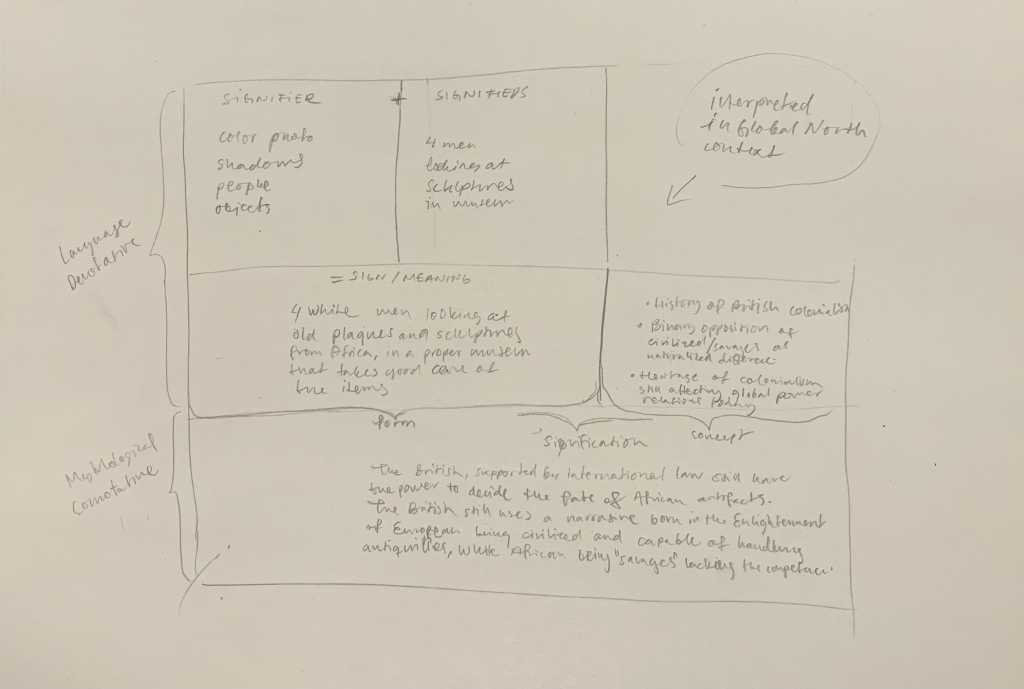
Implementation of the header image from History.com in Barthes’ structure for myth.

A bit harsh to say this image’s caption is distorting meaning, but some words are ambiguous. As well that is not the entire story on how The British Museum gained the Rosetta Stone. This is also a personal aspect for me as I consider the complexity of historic events to be important, otherwise you can’t get the full understanding.
This article uses quantity as a way to underline a problematic aspect of the British Museum’s collection. By counting out the amount of artifacts “borrowed” and stolen. This article also holds a quote from a representative from the British Museum saying why they won’t return any objects. Which is something not mentioned in the other articles. “the collections have to be preserved as whole” said British Museum Director Hartwig Fischer.
This article is using referencing as a way to enhance the multitudes of sources and initiatives that think the artifacts mentioned in the article should be returned. This article is not very positioned, but rather presenting and laying out the premises for these different artifacts in relation to the British Museum. A bit distant, in contrast to the Egypt source below. Could be because of the sender being American and having the privilege of being more objective in this matter, as well “#1 factual entertainment brand” tells us that what is expected of this magazine is not “radical” opinions but rather, just like this is: a presentation for better understanding of historical artifacts in contemporary contexts. A qualified suggestion would be that their target audience are History nerds, perhaps usually used to books on history, these matters treating postcolonial consequences might actually be new subjects to many of the readers and because of that the threshold is a bit lower for this particular article.
Words: stolen, return
Source 2: The Evening Standard, newspaper in London, England.
https://www.standard.co.uk/culture/british-museum-rosetta-stone-egypt-a3981736.html

This article is focusing on the fact that Egypt is opening a new museum in Giza, the text centers around quotes from Dr Tarek Tawfik, director general of the Grand Egyptian Museum. The text gives some brief historical background on the stone and then also a quote from the British Museum saying “We have not received a request for the return of the Rosetta Stone from GEM.”

The images in the article are from the new museum in Egypt. Second image in that gallery is of the Rosetta Stone. Through this report of the new museum however this article does not once mention the word stolen or looted so frequently used in many other articles on the return of the Rosetta Stone.
“It was handed to the British under the Treaty of Alexandria in 1801, along with other antiquities that the French had found” The wording “handed”, “Treaty” and then “found” can signify a peaceful and understanding way of attaining the Rosetta Stone. The formulation of this makes it sound like this is completely a matter of French and British historical politics. A personal reflection is that the formulation of that sentence reveals a postcolonial gaze whereas the true nature of obtaining artifacts from Egypt and other countries in the Global South at this time is veiled behind well chosen words. Perhaps this is a way to write from an objective perspective, but the lack of position can also become a standpoint.
Source 3: Albawabh news https://www.albawabhnews.com/3386722
Egypts official language is Arabic, so doing google searches in English might reduce hits from Egypt that could be valuable. A quick translation into Arabic gave this result. Due to the language barrier it is hard to establish what kind of news paper this is, it’s credibility and amount of people reading it, but Egypt had to be represented in this case study.

The article is discussing the issue with Egypt signing an agreement with UNESCO in 1970 being part of preventing them from getting The Rosetta Stone back.


This article has its base in critique on smuggling antiquities, illegal activities by smugglers–criminals, then seamlessly it goes into discussing The Rosetta Stone’s repatriation. Embedded is a lot of images of people with power in Egypt, or knowledge on the matter. Statements from these people include statements on theft on antiquities as well the returning of The Rosetta Stone. Is the use of these prominent voices from Egypt to condemn looting of historical artifacts a way to say that the British Museum is not more than a simple thief? But trying to unpack and understand this text a possible interpretation is that Egypt feels let down also by UNESCO and international law. Could the article be implying that the laws of the Global North are constructed to maintain the power relations from colonial times towards the Global South?

Words: smuggling, antiquities (plural), looted, illegal, UNESCO.
Some reflection
After reading the first article from history.com I decided to google the Director of the British Museum. I found a blog post from him regarding Black Lives Matter, written in june 2020.
A text that in this context can seem almost unworldly. I wanted to include this as a side note in this study as my chosen case study and specially his blog post got me thinking of one of the most convincing things I heard during Black Lives Matter movement that year. A woman, Kimberly Jones, who said “The social contract is broken”, “YOU broke the contract” and “are lucky what black people are looking for is equality and not revenge”.
I often think about exactly that. How minorities and unjustified groups and people most often is just looking for equality. After centuries of mistreat, abuse, slavery, all of humans darkest sides displayed toward fellow humans. And after that all that is asked for is equality, but that is unattainable. What would happen if Egypt stopped asking and just took what is theirs? Is it possible to steal a looted object or is that just reclaiming it?
Critical review, text
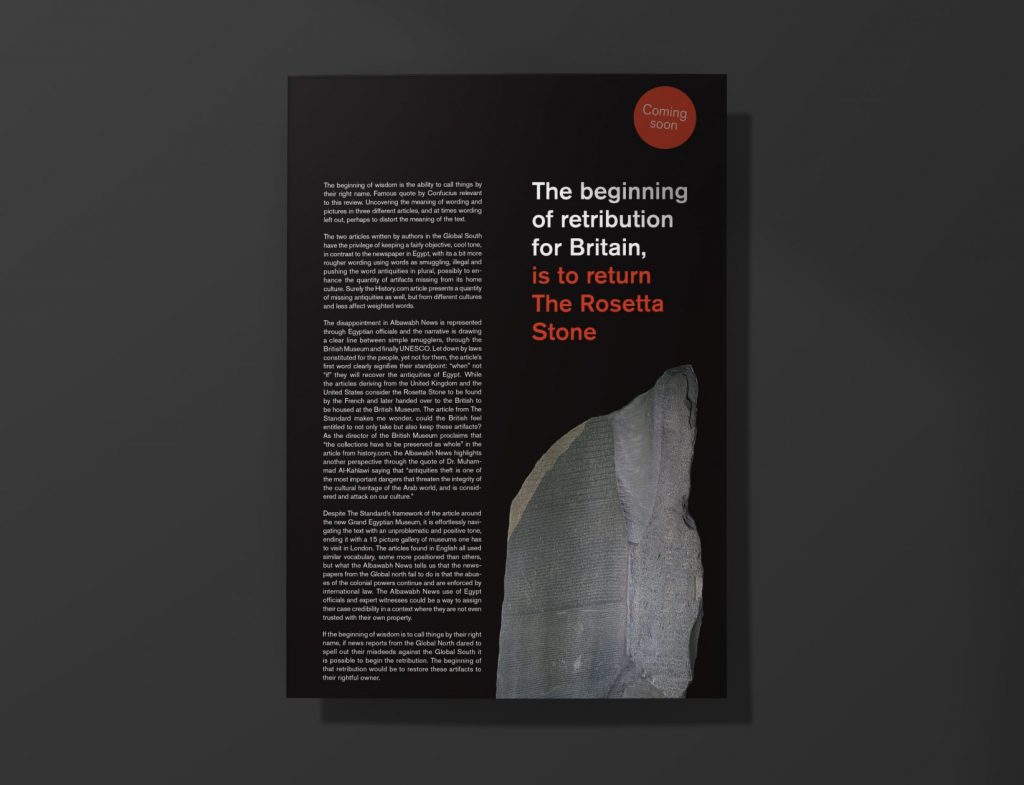
The beginning of retribution for Britain,
is to return The Rosetta Stone
The beginning of wisdom is the ability to call things by their right name. Famous quote by Confucius relevant to this review. Uncovering the meaning of wording and pictures in three different articles, and at times wording left out, perhaps to distort the meaning of the text. The two articles written by authors in the Global North have the privilege of keeping a fairly objective, cool tone, in contrast to the newspaper in Egypt, with its a bit more rougher wording using words as smuggling, illegal and pushing the word antiquities in plural, possibly to enhance the quantity of artifacts missing from its home culture. Surely the History.com article presents a quantity of missing antiquities as well, but from different cultures and less affect weighted words.
The disappointment in Albawabh News is represented through Egyptian officials and the narrative is drawing a clear line between simple smugglers, through the British Museum and finally UNESCO. Let down by laws constituted for the people, yet not for them, the article’s first word clearly signifies their standpoint: “when” not “if” they will recover the antiquities of Egypt. While the articles deriving from the United Kingdom and the United States consider the Rosetta Stone to be found by the French and later handed over to the British to be housed at the British Museum. The article from The Standard makes me wonder, could the British feel entitled to not only take but also keep these artifacts? As the director of the British Museum proclaims that “the collections have to be preserved as whole” in the article from history.com, the Albawabh News highlights another perspective through the quote of Dr. Muhammad Al-Kahlawi saying that “antiquities theft is one of the most important dangers that threaten the integrity of the cultural heritage of the Arab world, and is considered and attack on our culture.”
Despite The Standard’s framework of the article around the new Grand Egyptian Museum, it is effortlessly navigating the text with an unproblematic and positive tone, ending it with a 15 picture gallery of museums one has to visit in London. The articles found in English all used similar vocabulary, some more positioned than others, but what the Albawabh News tells us that the newspapers from the Global north fail to do is that the abuses of the colonial powers continue and are enforced by international law. The Albawabh News use of Egypt officials and expert witnesses could be a way to assign their case credibility in a context where they are not even trusted with their own property.
If the beginning of wisdom is to call things by their right name, if news reports from the Global North dared to spell out their misdeeds against the Global South it is possible to begin the retribution. The beginning of that retribution would be to restore these artifacts to their rightful owner.
Design development
Naturally this should be something for The British Museum, with them as the sender. So the approach for my visual research was the Design Guidelines for The British Museum. I chose the on-site poster.


I simply applied the guidelines for their grid to the poster format for the on-site posters. Worked out the typographic hierarchy in Akzidens Grotesk that is The British Museum’s type de choix.
Did not dare to put their logo on the final outcome though.
Following the guidelines and setting the text gave quite a quick development this week. But the outcome was ok, the typography got some attention.
Final outcome
Reflections
Visual outcome: At first I thought it was a sneaky idea to make this into a British Museum poster, at the same time it is definitely one of my weaker outcomes? Did I just resort to my old habits of typographic comfort? I did, didn’t I? Looking at this outcome I think it could have extended the comment I am trying to make with my composition, if I made an analysis on who to deconstruct or alter it? Perhaps a little research on possible practical approaches on decolonising composition and typography, and apply them to the outcome of the poster?
This week I felt incredibly insecure on my interpretation of this challenge, on
wether the way I wrote was the intended way. If I included enough from the resources on semiotics etc. I am also very insecure on how positioned I should be in general, am I being perceived as opinionated? Should I rather focus on evolving more visually? The truth is I rarely care that much about my opinions, the discussions are more a vehicle for my development. That is basically how I see Academia, an opportunity to exercise the mind and trying out standpoints through research. Below some exercise of the mind on censorship from this weeks ideas wall:


References
Figure 1: Magnusson, David. Available at: http://www.davidmagnusson.se/purity/purity
Figure 2: Robinson, Andrew. The Story of Writing: Alphabets, Hieroglyphs & Pictograms. London: Thames & Hudson 2000
Rose, Gillian. 2016. Visual Methodologies. An introduction to Researching with Visual Materials. 4th edn. Sage Publications.
Crow, David. 2016. Visible Signs: an introduction to semiotics in the visual arts. London: Fairfield Books.
https://www.standard.co.uk/culture/british-museum-rosetta-stone-egypt-a3981736.html
https://www.history.com/news/british-museum-stolen-artifacts-nigeria
https://www.albawabhnews.com/3386722