User
The primary user is the absolute upper class of Sweden, »the 15 families« (a concept coming from the left party in Sweden’s then leader: CH Hermansson as he mapped big businesses ownership in Sweden in the book »Monopoly and big money—the 15 families« in 1965 that stated that a small group of families hold huge assets in Sweden.)
I created an outline for my user from researching these families and one of them in particula: the Schörling Family. The family is known for their business with illegal palm oil (Ståhl 2020) that has resulted in the burning down of nature reserves in the Indonesian jungle, reserves that have been replaced by palm oil plantations. The sustainability report for that company, however claims that it »continues to report significant progress in the area of sustainability and contribute to the UN’s goals for sustainable development.« (Schörling 2020)
This connects to the previous note on how problematic it can be to rely on other’s self perception in relation to environmental impact.
Archetype
Demographic
Female
30-40 (born in 70’s-80’s)
Mscs in economics
No or young children
Lives in central apartment in Stockholm
Heiress to a number of Swedish companies
Motivators
Surviving
A livable future
Goals
Live a life similar to
the one lived on earth
Socioeconomic class
Capitalist
Environmental impact
Extreme on a global scale

The Mima is a kind of divine AI in the book Aniara. Mima has archived the entire human history which can be accessed and helps the passengers to cope. In the book, Mima actually dies of sorrow due to her gathered insights about humanity. But in this idea she gets to live, as the emotional journey of the users might become too dark if she »passed«.
There is reason to problematise and discuss why the user’s emotional journey is mainly negative. The speculation in this project deals with the end of the world, which is a negative experience for the majority. This group of users are saved and invited to a continued existence. They are let aboard based on their life in excess and then forced into a life on the other side of that scale. This emotional journey might be part about learning that you are on a journey towards an unknown future and some about fundamentally shifting a way of life, where for the first time in your life you are disadvantaged by the system. There should be an opportunity for progression for the user. If this project was extended, the service could offer the most regulated users ways to balance out the regulation. The end mean would be a system where everyone is at balance, equally regulated. This come from a note from Anthony Dunne on letting the user be provided of new behavioral opportunities and let the product become a »role model« that can bring »about transformations of perception (and conception) in the user as a protagonist by embodying unusual psychological needs and desires in »pathological« electronic objects.« (Dunne 2006)
Defining and meeting the user needs
The user was somewhat depersonalised as the system peels off the fundamental parts of who they are. A part of the AI’s purpose is to create an existence of the typical Swedish welfare state’s grey mass. Therefore the service was designed to meet the most basic human needs. The core service, the interface, enables a life according to Maslow’s physiological and safety needs, while the enabling service, the Mima, allows the individual to touch upon the psychological needs.

Visual direction for interface
The aim for the interface was something with a retro futuristic feel as it can enhance the dry on the verge of crass tone of voice and the echoes from the past that the project is trying to capture. When looking for research, I examined the possibility of re-creating the gaze of an apocalyptic future as seen in visual culture during the 80’s. This has been done in remakes of movies (for example Blade Runner, Tron: Legacy) and video games (for example Fall out). Where these temporal aspects are put at play in the visualisation of an interface.
The interface for Aniara should, without any emotion, make it clear that Aniara stands in contrast to everything the user has stood for before. An indestructible system leading the user into a context where the only way of survival is a solidary mode of living. This includes some depersonalisation as the user exists solely for the communal, as a part of the grey mass.
The interface should peel of any traits from an imperial mode of living and translate them into a solidary one where:
Individuality becomes community.
Free market becomes state (ai) regulated.
Life in excess becomes life in modesty.
Superiority becomes equity.
Every activity of the user’s practicing their basic needs would relate to the interface and dictate the fundamental living standards.

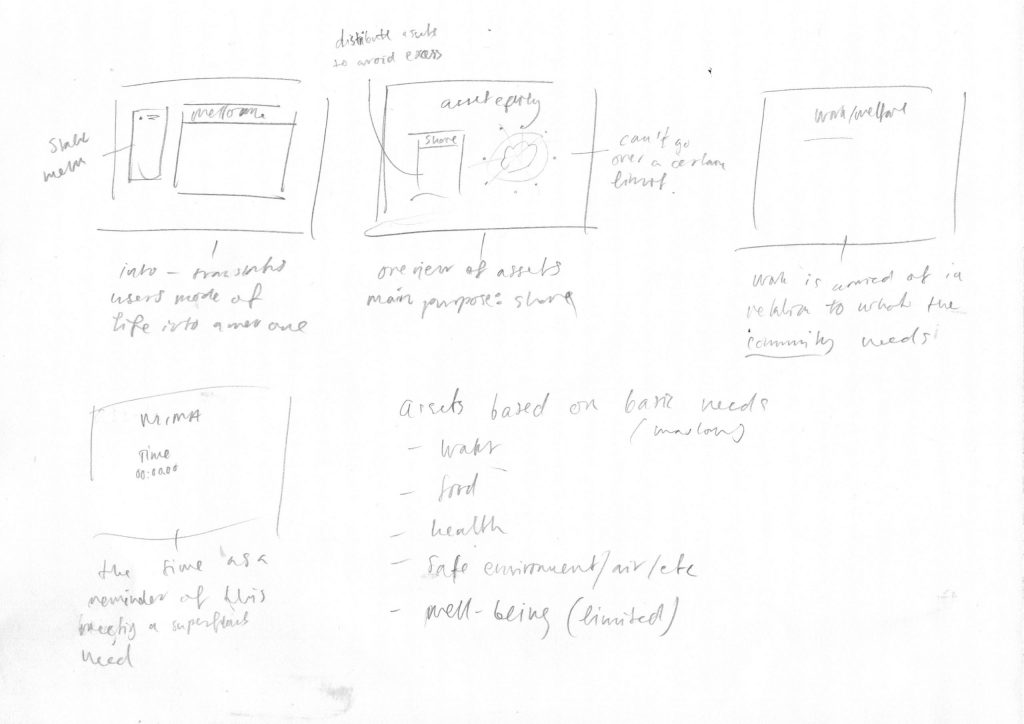
These initial sketches examined how to let the interface meet the user needs.

These first computer sketches were a way to make sense of the interface and relate it to the user journey.


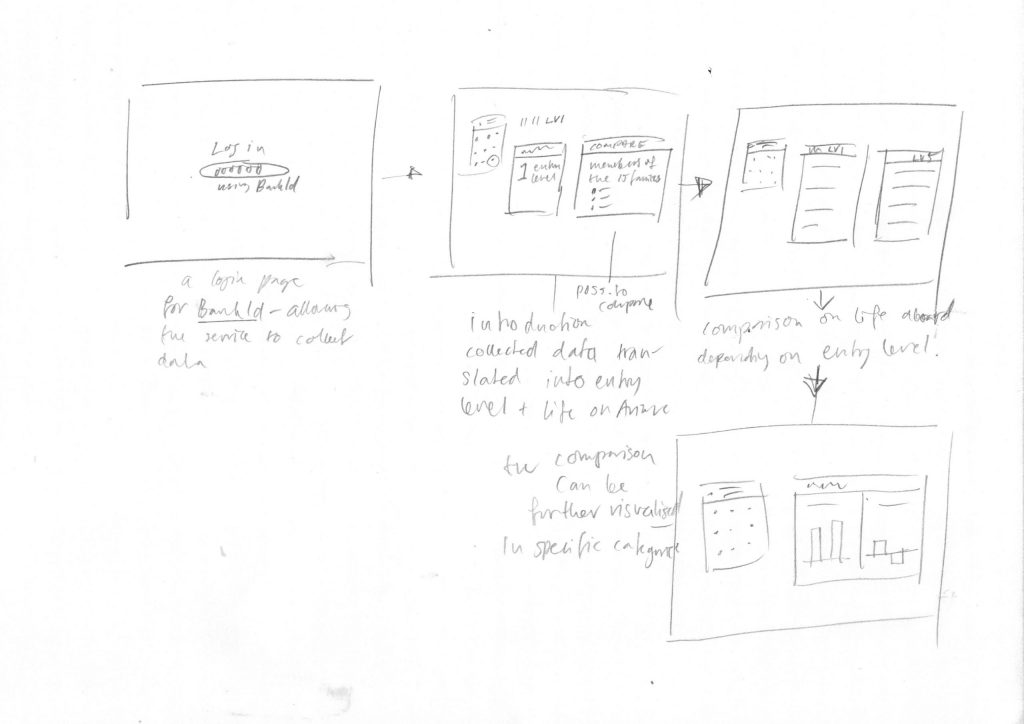
After finishing the final outcome and the entire idea was in front of me I asked myself where this would sit in a contemporary context and how it would function. How could it engage a target audience beyond the intended user? How could it increase consciousness of class in Sweden and initiate a discussion.
It could be developed into an exhibition or an online service where you would log on using your BankId (a Swedish service that connects your bank, insurances, loans, purchases, the tax agency, basically everything.) It could then create a personal profile on Aniara, enable interaction with the system where one could compare one’s profile with a pre-created member from one of Sweden’s 15 families to see how one’s respective life on Aniara would be depending on what harm one’s mode of living on earth has caused.
When presenting that information in a context that suggests that another possible, is possible it could hopefully raise some questions in the target audience on why the current system allows this extreme injustice.


The idea of the possible extension of this project was sketched out in Framer, directly relating to the existing interface. This idea could have connected the entire project from start, but this conclusion was a result from a project full of learning cycles. This final insight tied it together and met the projects purpose.