Activites this week
- Tutorial with Lina (teacher in graphic design and graphic design history)
- Reading and inventory of upcoming reading
- IMS seminar with Professor John Bateman on
- Webinar
- Peer to peer
Possible research questions
I am looking at my research proposal written in 730 and trying to figure out how I can take fragments of that into this project. The reason is that it can help me make better sense of that intended project and the research that will undergo in that. It can hopefully help me to better define theory and methods. For this project I have looked at the research questions and tried to relate them to my subject of analysis here which will be Western visual language.
Q1 Theoretical approach: What are the processes in which artefacts in the history of western visual language are still connected to ideological constructs and how do they inflict on value in contemporary meaning-making processes?
Q2 Practical approach: In what ways would it be possible to evade these processes and refract the lens of predominant ideologies in visual language?
Possible approach to project (now scrapped)
My project could contain of three parts
- The research that will end up as something written, the body of which my practical implementations to some extent will build.
- A container for this written piece, can be a journal, a booklet, a text on an exhibition.
- The refracted lens, a participatory activity that enables others to create outcomes of plural that can break the ideology of visual language. And maybe encourage to do so in different modes?
The third one could produce results that go into the first. And the third one could also be conducted online somehow and then I execute it practically somehow. There are a lot of ways to approach this.
If part three is in a particular context–will I have to consider the semiotic landscape of that?
Tutorial with Lina
I had a discussion with my friend Lina who has been teaching graphic design and graphic design history for more than 12 year. She is also my former colleague, she knows me and my way of work so I feel confident enough to discuss my rough ideas. Here are notes from our discussion:
If this is to become a participatory thing, a simple process (for the user) is key. To use this method must be a very simple thing.
We moved on to discuss what this lens that is going to be refracted is and what it means and she said it is basically like this:
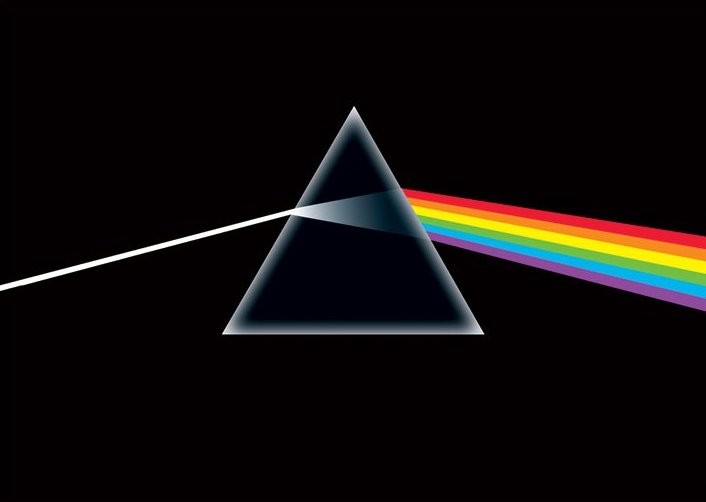
Something uniform, universal, our visual norm gets refracted and the result is a plural of possible outcomes.
We had a discussion on the object of analysis, I have been thinking about the latin alphabet. Lina said it is maybe a better option to look at something that is more cemented in its form. Something more specifik. She thought that the book is more clear (this is a reference to one of our previous conversations where I talked about the book as a sign carrier and organizer of knowledge).
The alphabet is not really a physical thing in the same way as a book. It is so changeable. Lina stated that the canon around book design is more solid, spread. From an art historic perspective, where they have not had written language the art has not been considered as ‘good’.
We were also discussing oral and written culture in relation to colonisation and the meaning of written language, the alphabet etc.
The alphabet as a construction is a bit abstract for this size of the project, Lina said and I knew she was right. She asked me to look for something narrower, where it takes a more physical form. I suggested maybe Western printed typography (that would be from 1450 and on) and Lina said that is a good idea, find a version of the alphabet that is quite standardised and maybe not include incunables as they are so similar to manuscripts. When she said that I suggested the roman type. And we both had a discussion on how the roman type is still predominant and that we today use the venetian roman type.
When looking at the printed letter there was a lot of oral cultures that was subjugated because of the spread of print. Could that be something to re-instate? What did get lost from oral culture when moving on to written culture and print? Could that be something to re-instate? That could take a multimodal form, and that can be about producing and storing knowledge.
To sum it up: I need to filter this object of analysis (printed letter for example) and what the user is supposed to be able to do with this “lens”. Lina said that this project can serve as a pilot study to my future research.
Reflection
I think the biggest problem is that I want to have already sort of done my PhD research, which I have not. I am trying to fit in big themes in a “small” project. Maybe I should allow myself to let this be a smaller fragment of what I want to do in future research. And allow myself to look at something “small”. It can be a diacritic sign. It is about ideologies in visual communication so I can zoom in on the smallest conventions and make something solid yet fun about that.
Maybe focus on printed typography from the Venetian renaissance?
Overturning the idea
I felt a bit locked in by this initial ideation and the way I have been thinking about this project. I sat down this week and just thought through possible approaches that could open up for me, put less pressure on me in terms of theoretical research–but still keeping a part of it that is possible to do during this time period and that feels like fun.
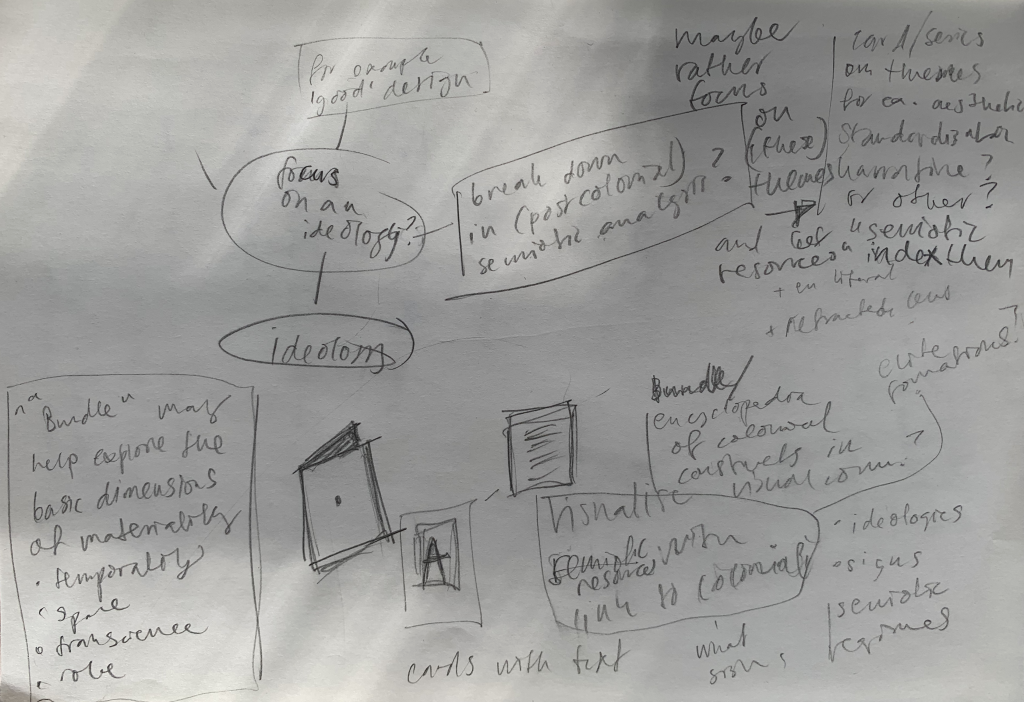
During my idea generation I came to some conclusions that resulted in scrapping a lot from previous thoughts on ideas. In an ambition to make this project more tangible and more approachable I thought of maybe focusing on overarching themes, initially I considered aesthetics, standardisation and narrative. But it will more likely just be aesthetics as I know that is something that is researched quite well in relation to colonial constructs, by Walter Mignolo for example. Aesthetics can also be regulated by and regulate standardisation and narrative–so they are in a way still included. This is not a firm decision, but a thought I have at this moment in the process.
My idea is to let semiotic resources (the actions, materials and artifacts we use for communicative purposes) represent the predominant aesthetics of certain ideologies that can connect to our present. These semiotic resources will be my primary object of analysis, it can be for example, Sweynheym and Pannarz first attempt for a letterform, the early printed book, an early printed book format, etc. Artifacts that represent ideological concepts that are still present in our visual language. These objects of analysis, the semiotic resources, are a collection of representational historical pieces of visual language. They are seen though the ideological lens of our cultural context.
These objects will be accompanied with a text explaining their origin, their position, their historical and ideological meaning hopefully through a multimodal social semiotic inquiry.
I did consider focusing on only one object of analysis, but after a discussion with an academic contact, he suggested more objects could prove or enhance the strength of my “refracted lens”. This can still change though. This idea can be applied to an object of analysis of bigger proportion if I want to. For example the Roman Alphabet. But for now the reflections of this idea is based on the notion that there will be several artifacts.
The refracted lens could be a speculative scenario stemming from the text based analysis of the object and refract the existing lens using social semiotics.
Is the lens overarching or changing depending on the semiotic resource? How does the collection look like in all through the ‘normative’ lens and through the ‘refracted’ lens?
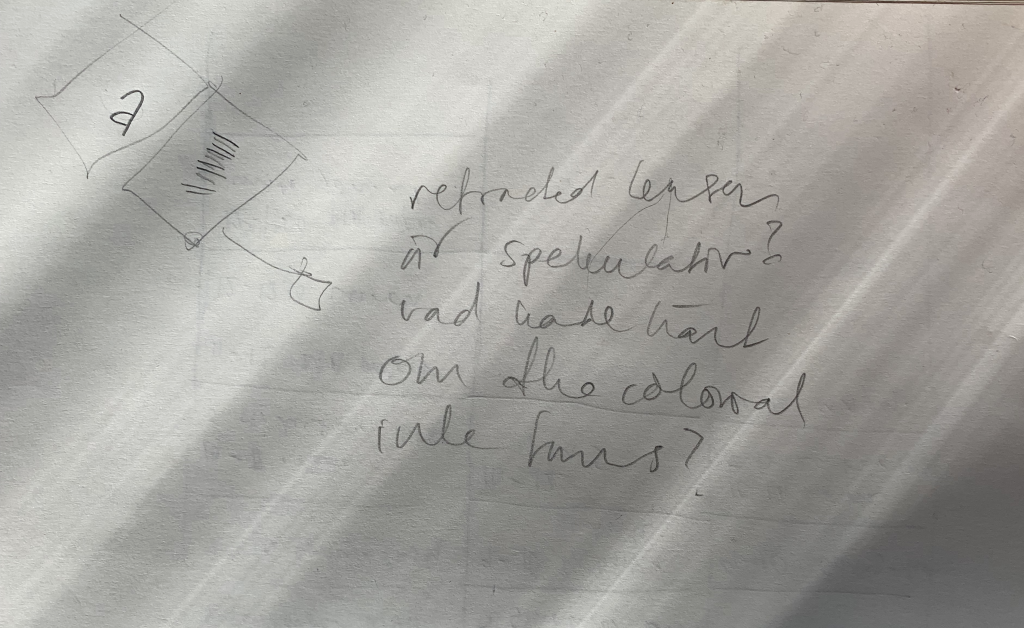
Sorry for the Swenglish, It says: Refracted lens is speculative? What would have happened if the colonial did never exist?
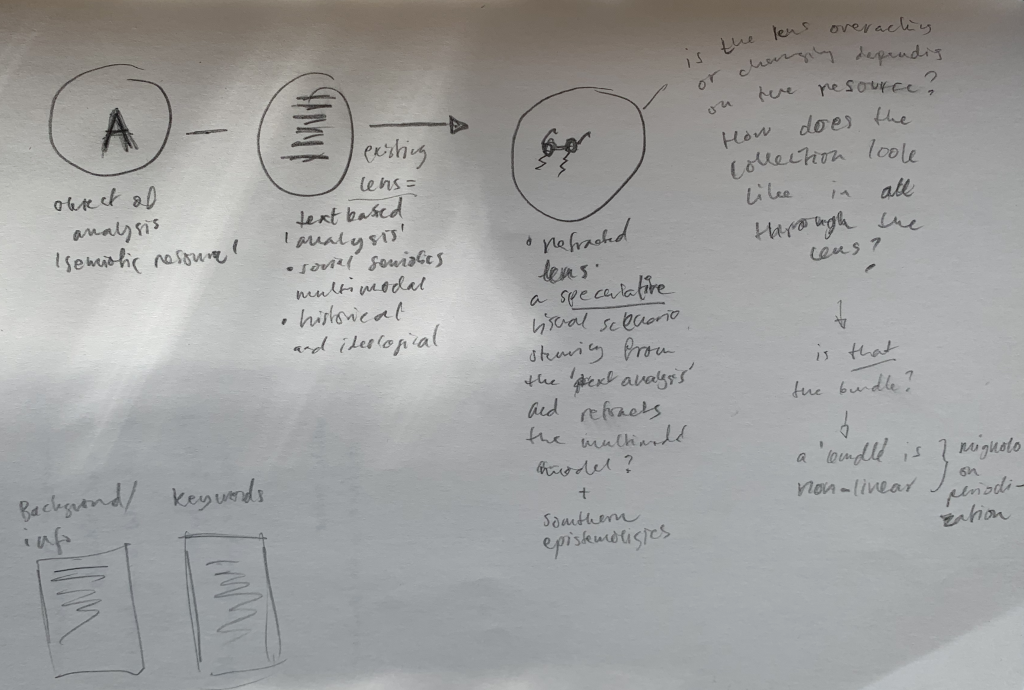
Trying to section my idea into something that could be deliverables.
I am thinking of working with a ‘bundle’ because that is something that will allow me to work with print, it will allow me to explore the dimensions of materiality and allow for a multitude of expressions. Working with a more free material context will also allow for certain material to take up more place and some much less. That gives me some freedom in terms of choosing and writing about certain artifacts. A ‘bundle’ is also not aligning with periodization which Mary Rambaran-Olm problematises as follows:
“Periodization has often been a product of white supremacy; the field’s persistent efforts to establish definitive dates to define itself emphasizes how “white supremacy evolves over time.”
The crux of periodization, though, is that it operates within the framework of white supremacy, prompting scholars to view time both episodically and linearly rather than as a complex web. As a result, the dominant narrative highlights Western civilization’s “progress” and rise to superiority, while everything outside of the Western narrative diminishes by comparison.” (Rambaran-Olm, 2021)
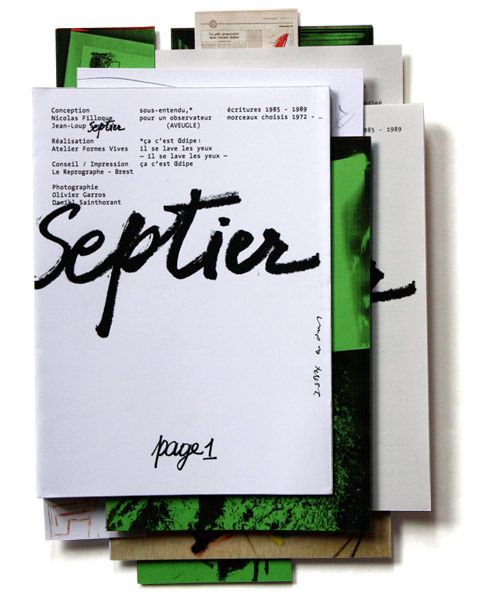
Maybe this ‘bundle’ or what it will be can be a way to try and get away from that periodisation. I will try and focus on the meaning- making, the processes and underlying ideological drives and try to make sense of how Western visual language was and still is trying to frame European at the apex of visual communication.
Rambaran-Olm also writes “Academic fields like Early English studies can only be saved through a cultural shift that requires structural, pedagogical, and generational changes but it is an important first step to begin interrogating why and how whiteness is centered.” ((Rambaran-Olm, 2021) Even though she is discussing Early English studies, this certainly can be applied to history of visual communication. Could my project question the tacit centering of Western ideals in visual communication and maybe even provide a lens that can visually challenge that?
Peer to peer
At the peer to peer when I tried to explain this idea I said that the ‘refracted lens’ can be like an equation and I can just give it to anyone and they will be able to produce a visualisation from that, so the lens can provide endless variations.
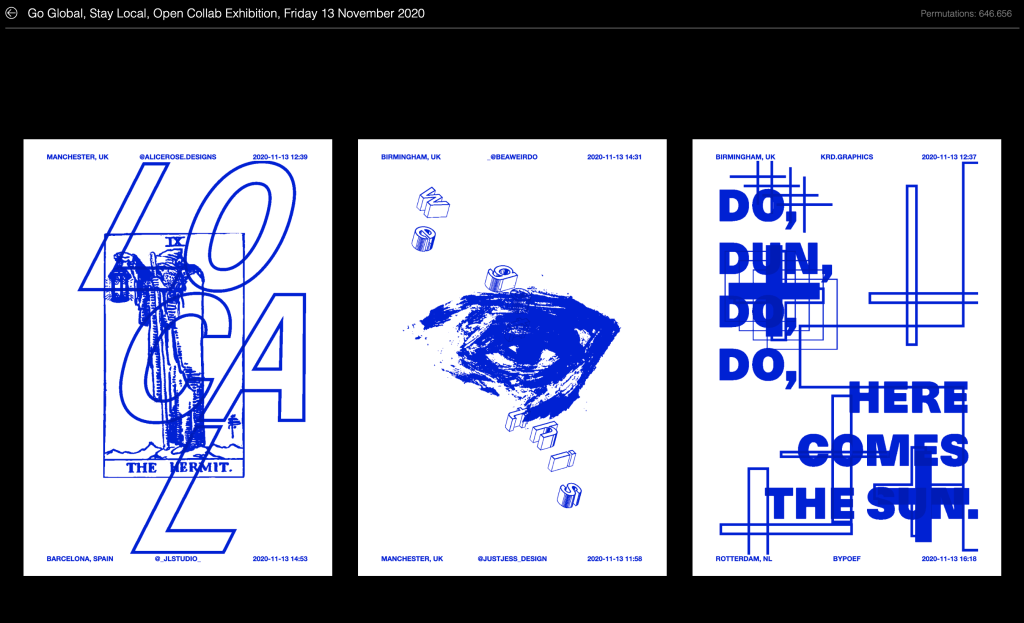
James then reminded me of Patrick Thomas ‘Open Collab’ and I think the simplicity of that is something I should explore. Something fun and engaging, simple to use. But it can also be analog, or as a recipe.
I need to consider if I should create a context for these generated outcomes.
Larry asked if this was more like an archive, and James added that he had thought of the concept of it being an archive as well. That really made it more tangible for me? I guess I am very much in my head at the moment, those contribution that makes it a bit more tangible for me are super helpful.
How to move on?
I think I need to make a small pilot study of this idea, where I chose and write about an artefact in small scale, apply the multimodal social semiotic approach and try and work out this refracted lens using semiotic theory.
This smaller study will probably help me understand what is possible, what is not and hopefully it can reduce the most uncomfortable insights at an early stage.
References
RAMBARAN-OLM, Mary. 2021. ‘A Wrinkle in Medieval Time: Ironing out Issues Regarding Race, Temporality, and the Early English’. New Literary History, Volume 52, Numbers 3/4, pp. 385-406. Johns Hopkins University Press. Available at: https://muse.jhu.edu/article/846838