Lecture with Martin Hosken
Curiosity–Philosophy–Methodologies
My definition of research: reading and gaining new knowledge on a subject, combining with existing knowledge making conclusions from that in written form or through design.


Reading the literature I got stuck on a section in Brenda Laurels “Design research; methods and perspectives” I posted a reflection on the ideas wall, hoping for some refreshing academic banter and opposition. But nothing. Maybe it was my crass approach that scared people off? I just have a really hard time with presumptuous excuses for not implementing knowledge that could be valid for your work. The worst *density in prose* I ever read was probably Elizabeth Eisenstein’s ”Divine art, Infernal Machine” but at least I had the good manners of knowing where the frustration over my inability to understand it all belonged.

← Update aug 18. When revisiting old ideas wall’s I saw that Alli had actually responded to my post on the Brenda Laurel text! “whether we should rise to access knowledge or demand knowledge to come down to us” yes, well said. I also fully agree with Alli’s viewpoint on engaging at levels based on how purposeful it is. As I find that is a big part of academic studies, to navigate and curate what resources are useful. As at this level that is also part of shaping ones identity. Thanks for replying Alli!
The lecture with Mirko Borsche was lovely and a huge privilege to be able to meet him. He said one thing I reflected a bit on: “There is not an objective measurement of our work” He is right, there is not really, but at the same time there are objective measurements in parameters defining our work. Rules for legibility, results on research leading the design, analyses and theories reinforcing the work we produce. I had written down three questions but didn’t have the time or courage to ask them, him being verbal in political matters makes him an interesting person to me. As well it is always great seeing someone working with such great success also being so humble.
Challenge
The description of this week’s challenge was a bit abstract for me, as I was unsure of whether I should construct a narrative to an object that doesn’t have much of a story behind it, mainly a function? Or go for an object on which I could do proper research. I guess my incomprehension of this weeks challenge finally led me to one of Martin Hosken’s sayings on research: “to place the primacy of the individual voice and your authorship at the centre of the process.” Therefore I thought I should choose something I care about, but don’t know much about and take this opportunity to understand more about this object. Then it became obvious to me I had to pick The Complutensian Polyglot.
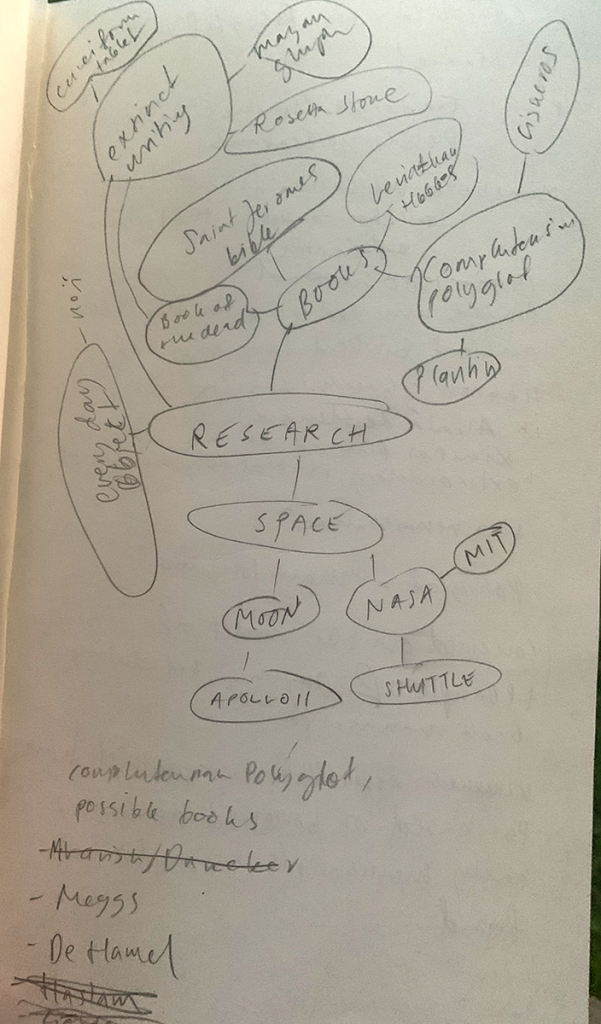
A short little mind map on possible objects driven from my own curiosity and after settling for The Complutensian Polyglot I evaluated possible literature. Looking first at books in my shelves, then online. When reading and researching, I write–that is basically how I think. I fill margins with text in the actual books but also my notebook. This is extremely time consuming and probably not very good or efficient study technique, but it is what it is.
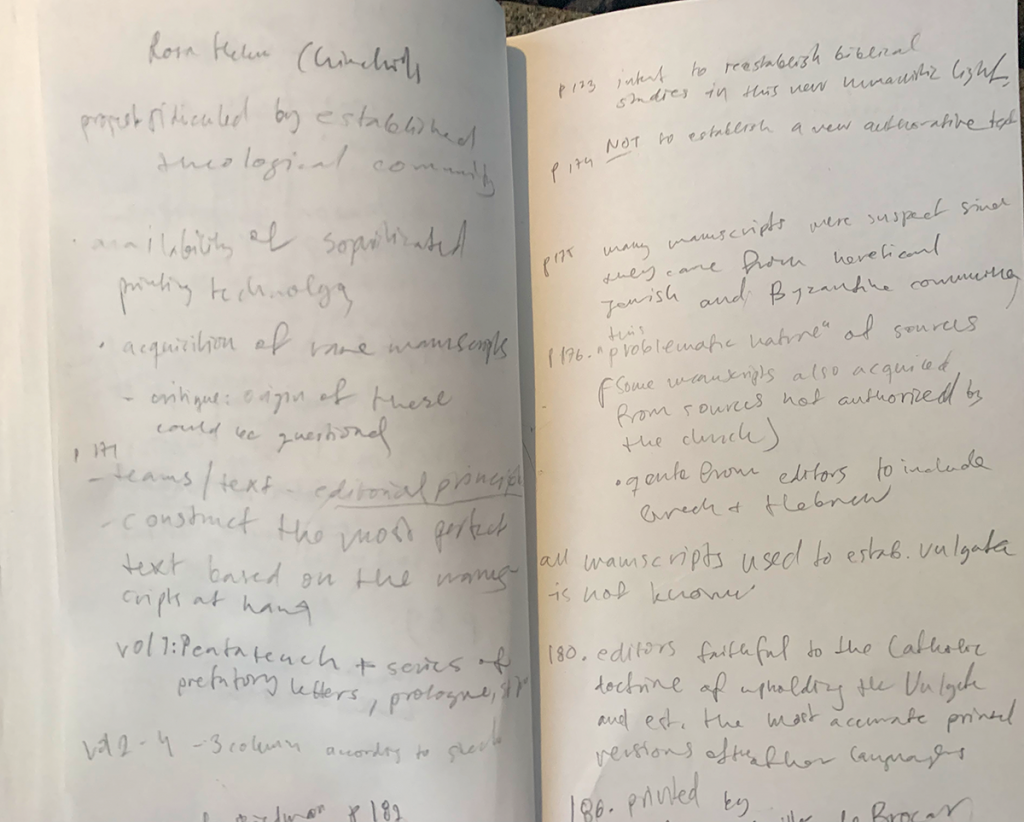
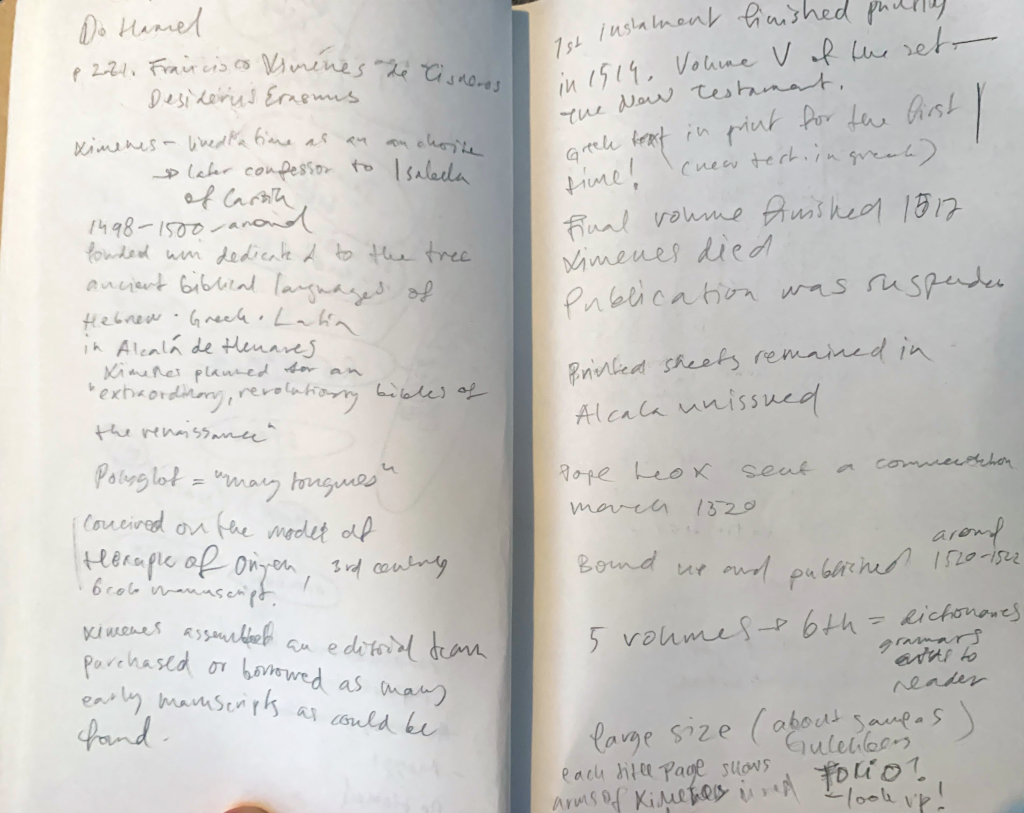
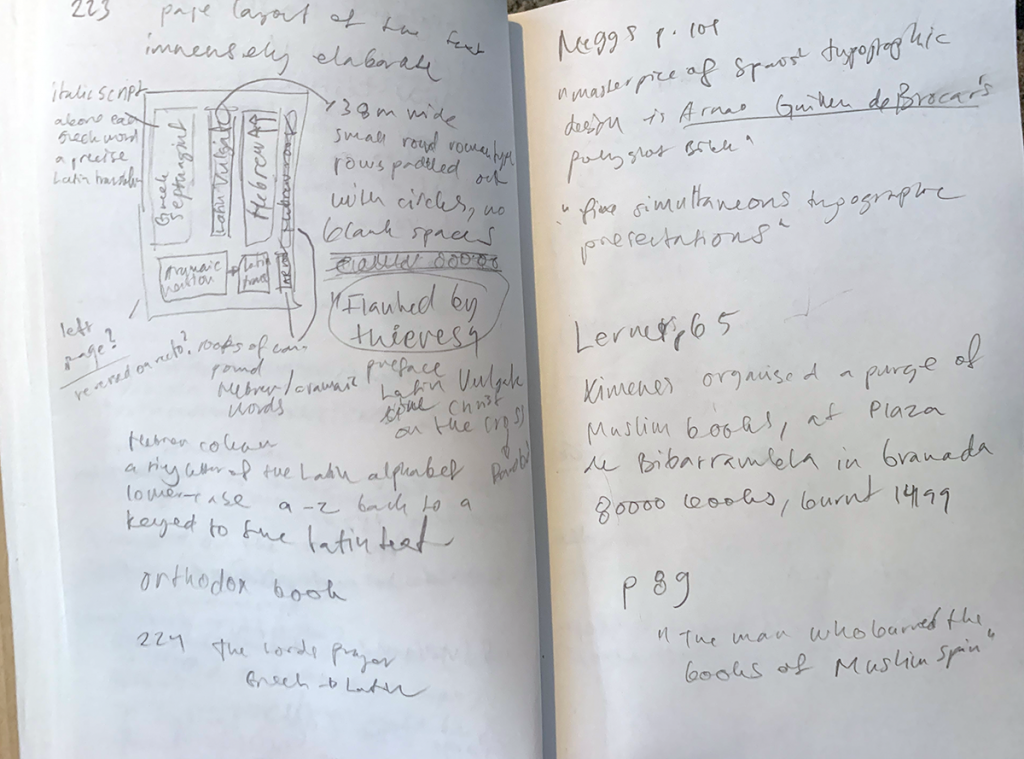
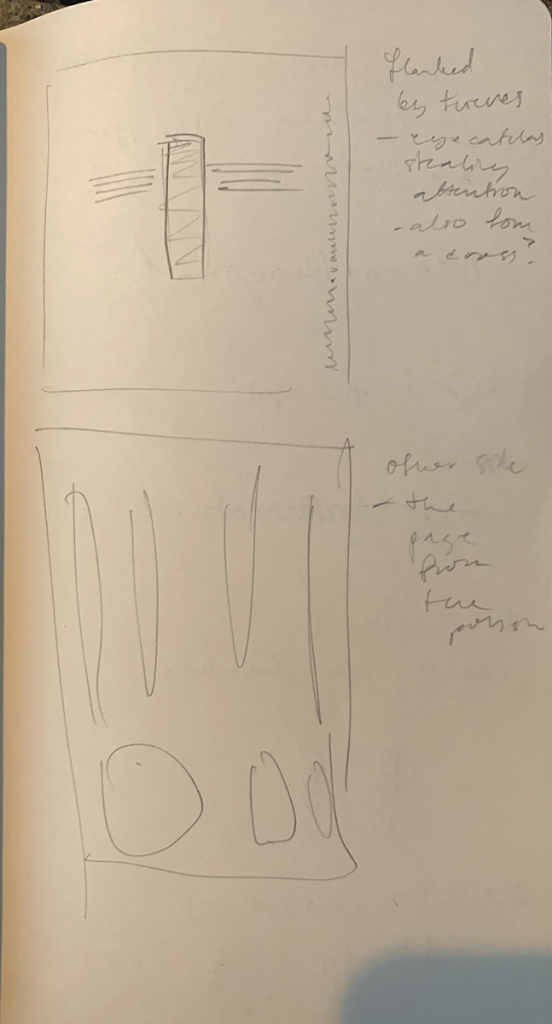
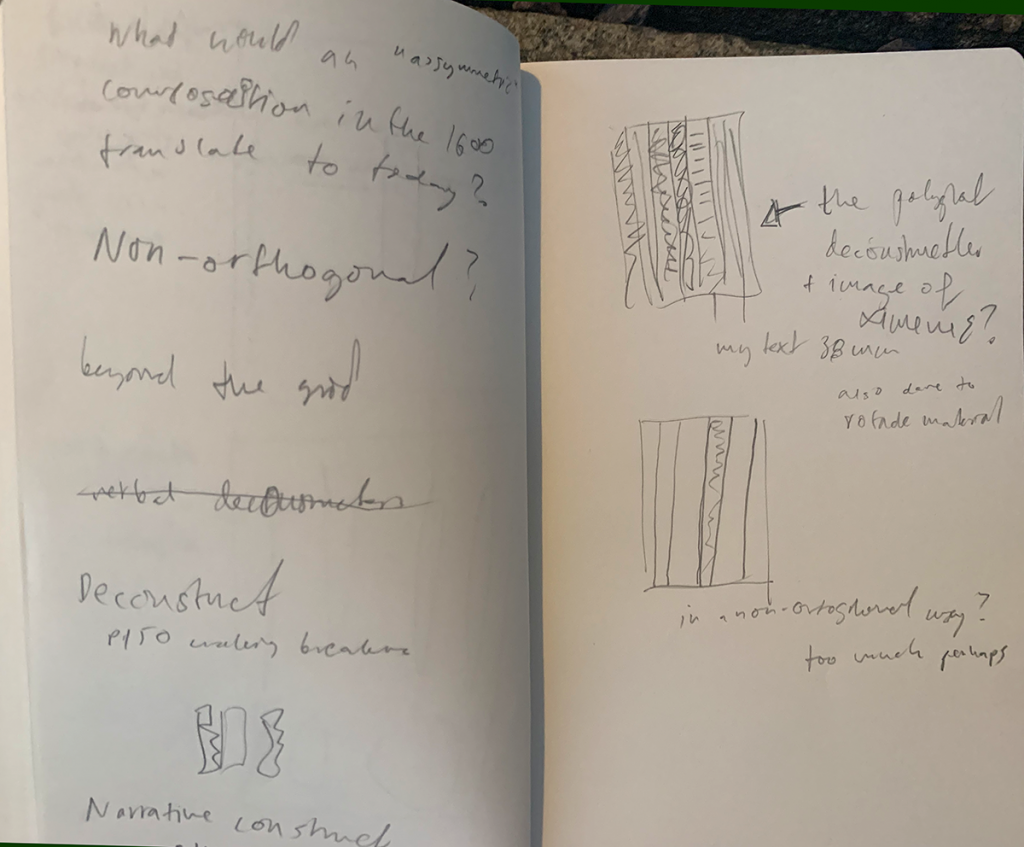
I also did some research on more contemporary approaches to layout and composition. “What would an asymmetric, multi-column layout in the Renaissance translate to today?” Non-orthogonal? Something beyond the grid? Deconstruction?


First computer sketches, not at all what I was looking for. Tried contrast in size but did not create the composition I was looking for.
I did some reading in Making & Breaking the Grid, with the hope for some guidance, and decided on some sort of mix of narrative construct with a hint of a non-orthogonal structure.
For the text I wanted to find an approach were I tied together the complexity of a certain time in relation to this particular object. Reading and writing about history is taking into account a world of circumstances. The Complutensian Polyglot turned out to be not at all as obvious as I first thought but rather a compilation of these complex relations during this time in Spain.

I worked with a Folio format just like the Complutensian Polyglot was set in. As well 38 mm for my text as the width for the Vulgate was. And in some deconstruction replaced the Latin Vulgate with my text, even though a piece of the Latin can be seen on the left edge. Trying a more non-orthogonal approach (sort of) for the final result. Cisneroa is looking away from the Vulgate in an eternal gaze over the texts he marked as “thieves”, and the new equivalent to the Latin Vulgate–my text (well, that can definitely be discussed)
Final outcome

The Complutensian Polyglot
Before approaching this beautiful object one should take into consideration the character of its creator. Francisco Ximénes de Cisneros a Spanish Cardinal who 3 years before he initiated the work with the worlds first multilingual bible followed the inquisition to Granada where he also organised a purge of Muslim books, burning no less than 80 000 of them. As Fred Lerner states “The man who burned the books of Muslim Spain”. Ximénes then assembled teams that began the meticulous work of translating for The Complutensian Polyglot Bible.
The Complutensian Polyglot’s multicolumn, asymmetric and dynamic layout gives the feel of being before its time, but the fastidious composition is still a product of its zeitgeist. The middle column is the Latin Vulgate, and in the Polyglot’s preface this particular column, is said to be the equivalent of Christ on the Cross, where he was crucified with thieves on each side. If the Complutensian Polyglots composition echoes these three crosses, the preface tells us that the Greek and Hebrew translations are not as worthy as the Latin one, that they are the equivalent to thieves. The editors of the book were all working with the ambition to vindicate the Vulgate and to construct correct renditions of the Hebrew, Greek and Aramaic versions. The inclusion of these texts was also questioned in regards to their sources, being collected rare manuscripts. These were possibly coming from communities of Jewish and Byzantine origin, meaning heretical. The project’s purpose was to create the Sacred Scriptures authentically. It took 15 years to finish, and another three to get published. It was mocked and questioned during the process from the outside while the fundamental beliefs dictated the work on the books literal inside and after its publication it was considered an heretical influence by the Inquisition. An object of many tongues in a world trying to prevent many thoughts.
Reflection
I honestly don’t know about my work this week, or my place here. I did the reading and writing and challenge and idea wall but I felt misplaced. Didn’t even have the energy to check the typography in my final composition which is unlike me and that is obviously also the reason it looks a bit… neglected. Maybe this will all feel better next week.
The editorial was a step in a new direction for me, using Samara’s examples from beyond the grid, as a navigational help when exploring alternative compositions, was really helpful. In a further development of this composition I would have investigated to push the non-orthogonal approach even further. Perhaps try working with the page as having a dimension in depth as well. Could have been enhanced through structure, but also by the use of focus for example. Something that could have just pushed the feel of the composition towards something “new” or norm breaking in its context.
Regarding the research, this opened up a lot of historical connections for me that I have not reflected on before. Reading about Francisco Jiménez de Cisneros burning the books of muslim Spain with the Spanish Inquisition I slowly realised that must have required involvement by Isabella I of Castile. Then I finally catched up with the rest of you and realised that they lived during the same time in the same place. I rarely reflect on all of these parallell stories existing at the same time, I just read about them in different books and don’t really connect them. Anyway, this context explained the incentive for some of the visual choices in the book. And for you, Englishmen–Isabela I of Castile, as you might know, is the mother of Henry VIII’s first wife Catherine of Aragon. So The Complutensian Polyglot was published during the time their marriage was still ON so to speak. Sorry for this 16th century anecdote.
References
De Hamel, Christopher. The Book. A History of The Bible. London: Phaidon Press Limited 2001.
Chinchilla, Rosa Helena “The Complutensian Polyglot Bible (1520) and the Political Ramifications of Biblical Translation.” Traducción en el medievo y siglo XVI en la península ibérica. Recio, Roxana, ed. León: Universidad de León, 1996. 169-190.
Lerner, Fred (Frederick), The story of libraries: From the invention of writing to the computer age, Second edition (New York & London: Continuum, 2009).
Samara, Timothy, Making and Breaking the Grid, Rockport Publishers, 2018.