Positioning statement
The project aims to diversify the perception of science and challenge hegemonic knowledge. Through inviting the target audience for participation in creating new narratives, they will be given an opportunity to discover more of the collection and to open up hidden objects to others, thus contributing to a more equal archive.
Analysing trends
After trying to develop my strategy and direction for the Science Museum project I wanted to look at how decolonial and participatory approaches look like in practice and applied to digital archives. Most museums, for example The Science Museum is working toward decolonial practices. One common approach for larger institutions are discussion groups and/or workshops, for example Contemporary Art Society’s “Doing the Work”. For this trend analysis I wanted to explore more on how this approach and theory actually looks when applied. Having attended a lecture by Neema Githere last week, her work was an appropriate starting point for this. Navigating her are.na really gave some valuable resources and another one on alternate archival interfaces and approaches.
Afropresentism
https://www.instagram.com/explore/tags/afropresentism/
This project is taking the authority of the narrative using personal experiences as a way to inform the public in a curational context, inviting others to participate. “a genre fusing archival, documentary and fine arts on and through new media in the navigation of an Afrofuturist lived reality“ More here: https://www.presentism2020.com/on-afropresentism
The trend I am trying to uncover here is probably the shaping of new relationships to knowledge and how to relate to them and how to free oneself from perhaps constructed views on for example storing that knowledge.
She who sees the unknown
https://archive.shewhoseestheunknown.com/
This is a really interesting project working with “exclusion” as a conscious tool for more decolonial approaches to the archive. So it utilizes “a series of language strategies and cultural codes that could, in effect, decolonize these existing power structures by protecting and preserving access to Arabic and Persian speaking people.”
The trend here is to decolonise the archive through re-figuring stories that are often misrepresented or forgotten but also preserving them through this layering of information in different languages.
Morehshin Allahyari is also working with a very interesting project where she writes fictional narratives around figures from west asian ancient stories in an attempt to explore colonialism and more.
https://shewhoseestheunknown.com/about/
Takachizu
http://takachizu.org/
A community archive built on storytelling and anecdotes around a shared cultural context. Quite similar to Neema Githere’s approach as well, a sort of open source knowledge bank.
A conclusion on trends
→ Taking the authority of the narrative and re-figuring stories that are often misrepresented or forgotten. This can sometimes also include shaping new relationships to knowledge and the storage of that very same knowledge.
→ “Exclusion” as a tool to create inclusiveness and preserve archives. Creating different layers of access or participation for different target audiences.
→ Collaborative storytelling. Creating participatory platforms for communities often from a shared cultural context.
Moodboards
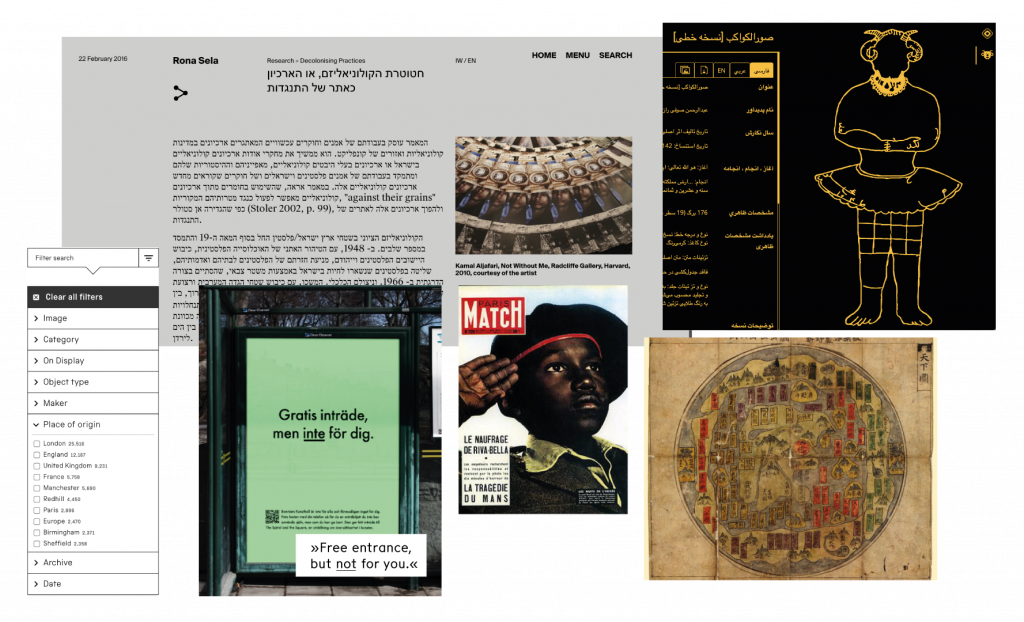
“Exclusion” as a tool to create inclusiveness and preserve archives. I have been looking at this from several aspects. One main thing is language, considering vernacular languages and oral culture historically being deemed as an inferior way of creating and storing knowledge. Making it a powerful tool that can be used as a way to lock out colonial powers/people from accessing information in full.
The Science Museum’s search form has quite a eurocentric view in the first level of places of origin, and efficent way to make information and objects more or less accessible. And next to that, the Bonniers Konsthall who worked with an outspoken exclusion in a campaign a few years back. Exclusion can also be used more ambiguously in terms of working consciously with semiotics, hence the picture from Match and Roland Barthes “Myths”. And work with different levels of myths that only certain parts of the target audiences can unpack. Exclusion can also be a perception on something, the world, as the Ch’ŏnha chido — Atlas of the world. A Korean atlas created sometime in the early Chosŏn dynasty.
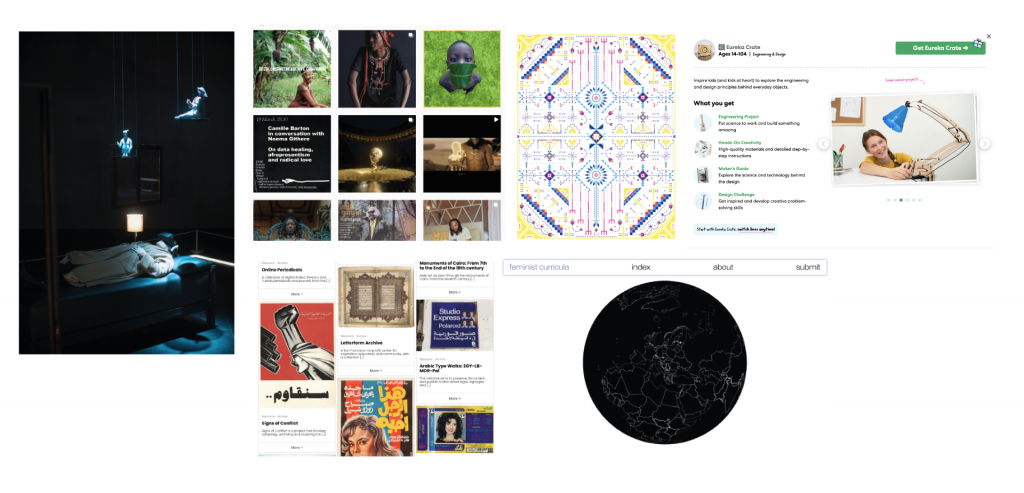
Taking the authority of the narrative and re-figuring stories that are often misrepresented or forgotten. For example Presentism according to theorist Douglas Rushkoff, society’s narrative has shifted into a decentralized participatory culture. Presentism is also interesting from a perspective of temporality in terms of lookin at an archive for example.
She who see’s the unknown–her own storytelling about ancient figures, presented in different outcomes. On the image one in VR. Afropresentism, the curation on a theme using an existing platform, here hashtag on instagram. Design Repository who is also responsible for the Arabic Design Archive. Saidie Red Wing’s project “Visual Essay” a project depicting a segment of a cultural context from a personal perspective. Feminist Curricula An open online directory that is mapping design educational initiatives that use feminist perspectives and pedagogies. It is built on the notion that people can submit themselves. From a trendhunter Kiwi crate–curated STEM kits for young people to learn and internalise the hegemonic knowledge of science.
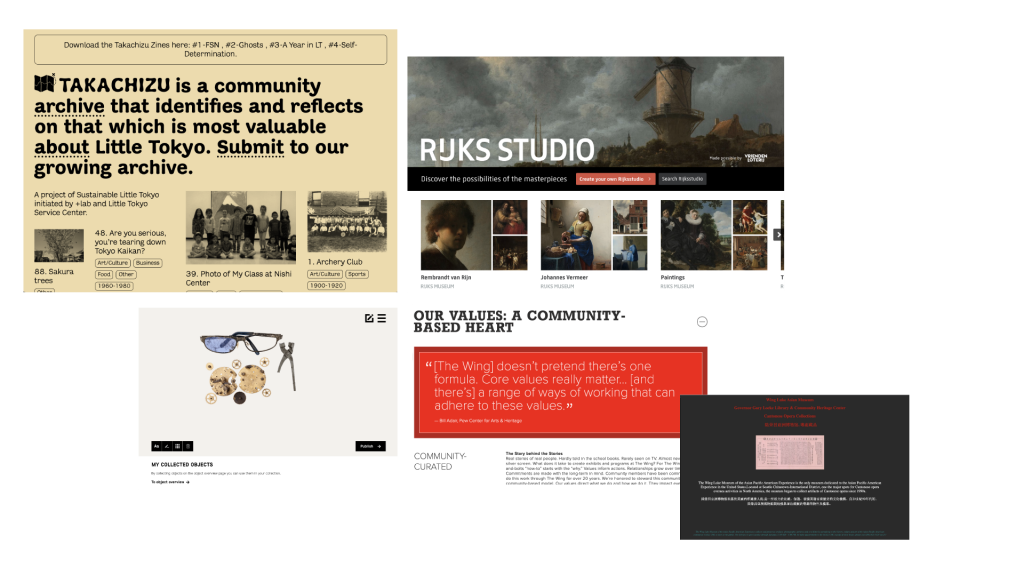
Collaborative storytelling. Creating participatory platforms for communities often from a shared cultural context. Takachizu as mentioned above, built on storytelling about and from the communitiy, Rijks studio where there is no difference between the small collections curated by the audience and the ones curated by the museum, Below the surface Amsterdam an archeological project aiming to tell the story of Amsterdam. Wing Luke Museum known for its collaborative approach, building experiences from the communities stories and contribution.