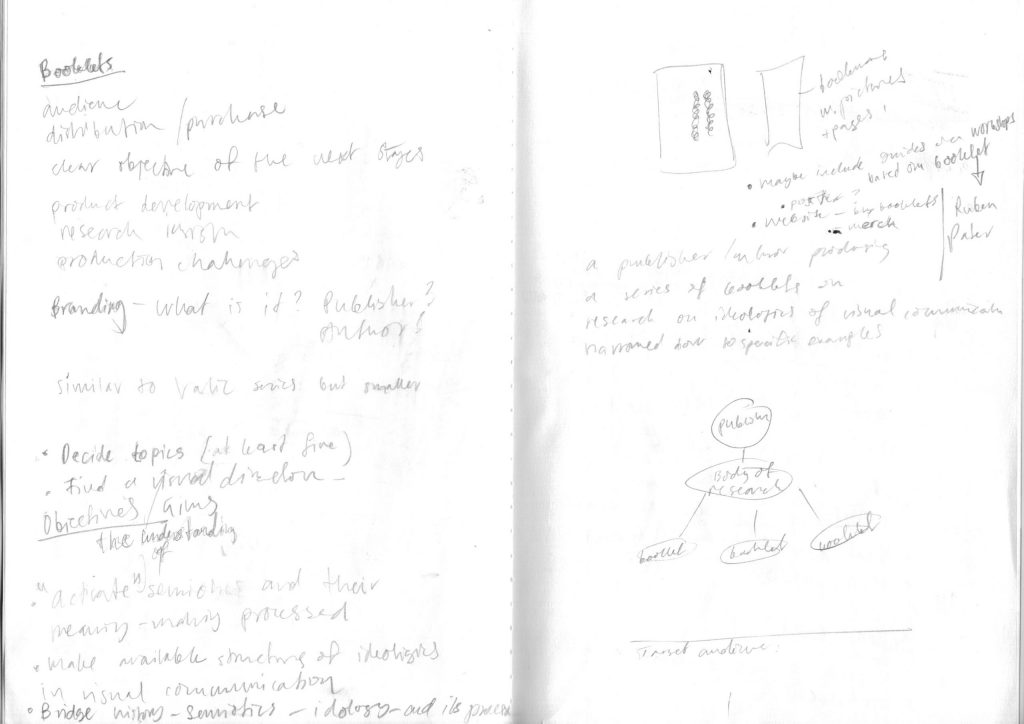
I decided to develop the idea of breaking up my intended research for my phd into a series of booklets. This could be a project that could be realised and developed in my Master project and be an appropriate preparation for a PhD. For the sake of this project, this idea will be developed from the perspective of it being a publisher.
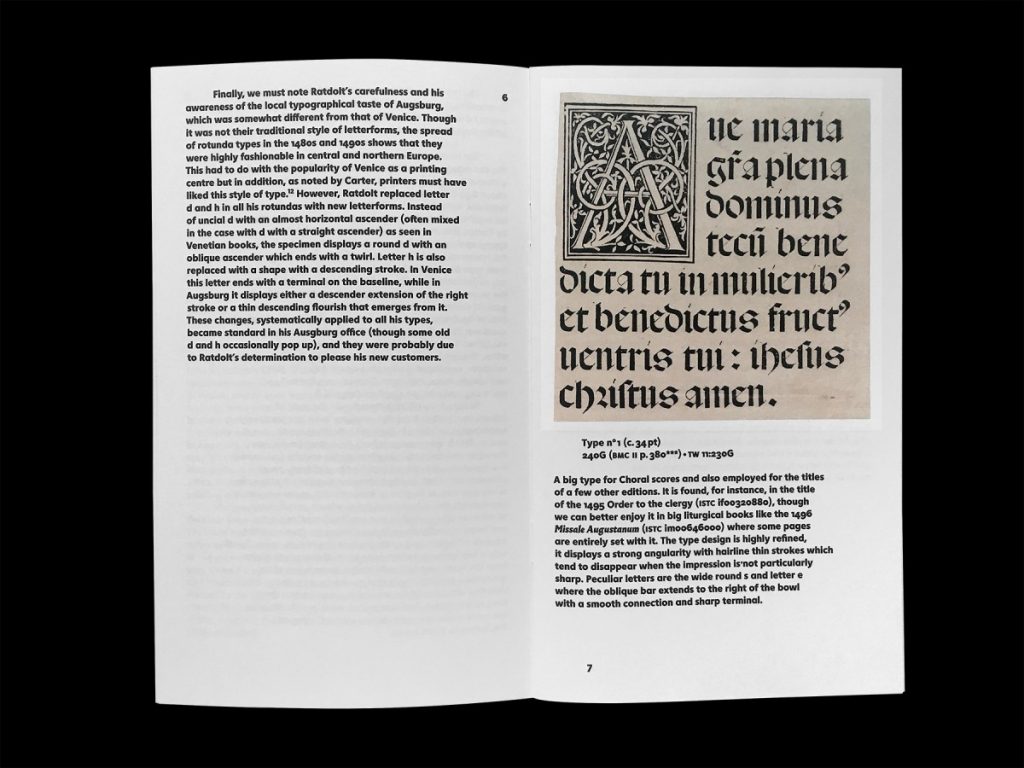
It would be similar to Poem Editions and their research heavy publications, especially their pamphlets that are small, accessible publications on topics in book history from mostly a typographic perspective. I have this one “Ratdolt’s Index characterum, the earliest known type specimen” that came with a poster of a facismile. I really enjoy ordering from Poem, because they are so good at adding that extra value. A poster, a postcard, etc. I have three postcards that I got when I ordered their book on Gotico-antiqua. Those postcards are hanging in my office. I would really enjoy making merch like that, but maybe the problem with my project is that the visual specimens that will be addressed are being so due to their link to the colonial. So possibly a bit inappropriate to make postcards out of them.
I need to decide on some possible topics and how I could break up my research into accessible subject that anyone would want to read and I need to find a visual direction for the publishing brand.
It would be a series of booklets on research on ideologies of visual communication, narrowed down to specific examples and approaches. For example through packaging of themes.
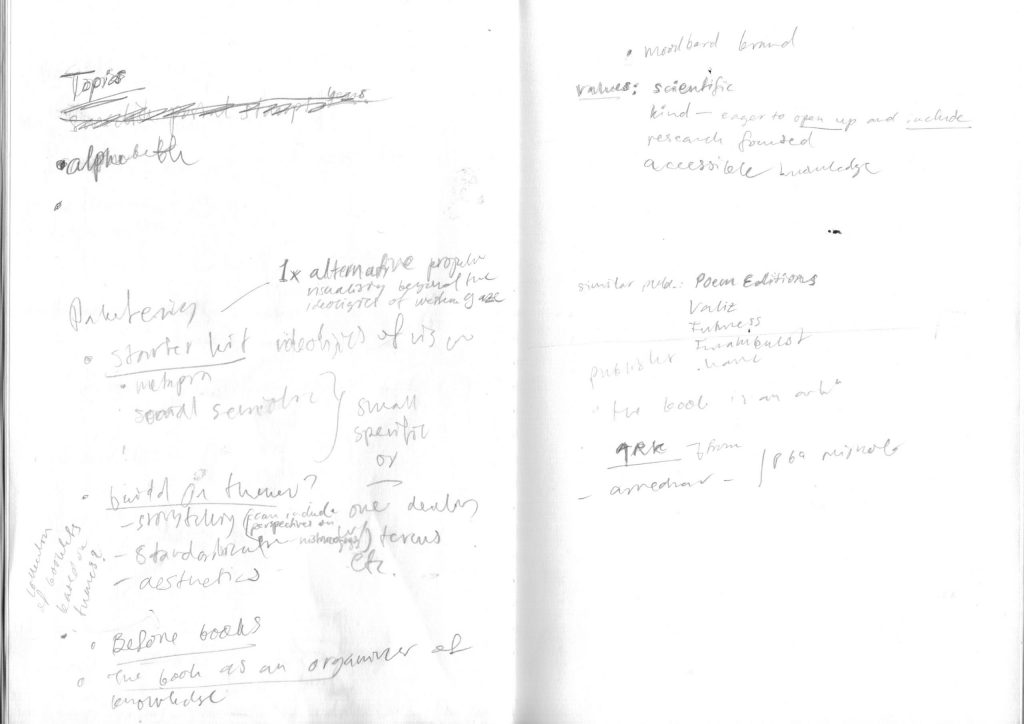
There could be like a “starters kit” laying out the foundation of the meaning of ideologies of visual communication, the meaning of metapragmatic discourse analysis, social and postcolonial semiotics. And then build on that through more thematized booklets.
Objectives/aims
- Activate interest of semiotics and their meaning-making processes
- Make available structures of ideology in visual communication
- Brigde history-semiotics-ideology and its processes
Values
- Scientific
- Kind and eager to open up and include
- Accessible
- Research based
These booklets could include guides and/or workshop guides similar to Ruben Pater’s educational resource kit for his book Caps Look. But a lighter one. Max Bloom mentioned on the ideas wall that a board game could be an appropriate way to make this material more accessible, and in term of using the research and turning it into some kind of practical learning material–that would be an interesting route to explore. In the scenario where this is actually a publisher, perhaps it is focused on learning contexts, where the target audience is educators (as Hoon suggested on the ideas wall). It does not only have to be academic educators but people who… educate, in any form within the field of visual communication.
Who, what, why and how?
Target audience
This is for educators working within the field of visual communication, with focus on graphic design and typography. They are motivated to deepen their understanding of visual communication, while refining their practical applications of theory.
These are people who recognize visual ideologies and want to be able to put a scientific framework around why that is, be able to verbalise its problematic origins and aspects, but also be able to provide an explorative practical approach to their students on how to work beyond these ideologies.
The secondary target audience are students in visual communication education of some kind.
What
A self-publishing company working with research and educational resources on ideologies of visual communication
Why
To bridge the theory and practice in visual communication and encourage educators to take a broader scope when investigating and discussing constructs within the field of visual communication.
How
Packaged research and educational resources for practical implementation in education of visual communication focusing on graphic design and typography.
Insight
The insight of this project so far is that not only can it build on existing research on ideologies of visual communication, but also bridge that theoretical foundation and provide for practical approaches.
Possible context
The context for this project is education on bachelor level (or equivalent) in visual communication with a focus on graphic design and typography. In Sweden there is a growth of consciousness in education of visual communication. Konstfack, Sweden’s largest university specialising in art, craft and design has a history of norm critical approaches in their education. The Linnaeus University reformed their education in Visual Communication a few years back by making it on artistic grounds and adding +change, not only to their BA in Visual Communication, but to all the courses in the Design Department in an ambition to encourage students to make change in the world and purposefully use design for a more sustainable future.
I did some research on these institutions where I mainly looked at how tutors and lecturers talk about these topics. I also looked at some student work and essays. It brought an insight that there can sometimes be a narrative around ideologies of visual communication that lacks understanding of the semiotic regimes that constitute them and the complexity of historical events that might have caused them. On the other side, looking at education from a scientific approach, the often discuss matters of visual ideologies where the discourse is lacking understanding of the driving force in visual narratives.
This project would connect all of these viewpoints and provide the well-needed bridge for that gap.
Research on print & prices
To be able to do the costings somewhat reasonable, I talked to my former print person, she is a project manager for printing projects and when I was working with my studio 2010-2018, she was basically always managing all our printing.
I sent some specifications to get an idea what kind of prices this would land on.
Specifications from me
I asked for price on an A5 format first, usually the standard formats are more cost effective. But that depends on how they print and if they print on roll or sheets. I know Scandia 2000 papers are usually delivered as sheets.
100 pages, probably too many but I wanted it to feel like a book.
Paper on inside: Scandia 2000 — 130 grams
Cover: Scandia 2000 — 240 grams
The paper is uncoated, high opacity and bulk.
Scandia 2000 is the house paper in some of the local printers, and it is a really good paper. Cost effective and produced in Lessebo. This feels like a hollow statement when planing to print 1000 books, but it is considered one of the worlds most climate friendly papers.
Colors: 4+4
I asked if it was possible to do a perfect binding. I am quite unsure of the premises for that kind of binding. I know an uncoated paper is better, and enough pages to glue on.
Edition: I asked for a price on 100 pieces, but I also asked at what amount they go up to offset and what the price difference would be. I would rather pay more in an initial phase and get it in offset + it will be a lower price per piece.
Print estimate
Everything in the estimate was basically how I wanted it. The only thing changed was my choice of paper. She recommended MultiDesign Original White in the same weights. The reason is that they have changed paper supplier. The MultiDesign correlates with Scandia 2000 in such that it also has a higher bulk, it is wood free, which usually means that it is quite age resistant.
The prices I received were the following:
100 pieces DIGITAL: 6 990 SEK
500 pieces: OFFSET: 27 550 SEK
1000 pieces: OFFSET: 33 850 SEK
The digital print would cost 70 SEK / piece and the offset 1000 pieces print would cost 34 SEK. I thought the difference between 500 and 1000 was so small, that it was more worth it adding 6300 SEK and get 500 more.
So I decided to calculate on the 1000 pieces. But I needed a booklet for the educational resources and asked for a price on the same specifications, but for 1000 pieces in A6 format. The price for that was 23 890 SEK.
These are all good prices, but if this was a real deal I would maybe try and negotiate a bit. My secret entrepreneurial flex is that I used to be really good at negotiating for better agreements, prices, extra stuff or other things.
The total price for the printing would land on 57 740 SEK, the idea is to sell these A5+A6 books in pairs. To reach a point of equilibrium it would require me to sell 321 pairs.
The Artists’ Association of Sweden
For possible pricing on the collaborations I went to see what the Artist’s association of Sweden recommend. They have different fees, ones for hourly rates depending on how you pay taxes in Sweden and one for more specific things, like lectures etc. I calculated the collaboration on an hourly rate for artists who pay F-tax in Sweden (meaning that they will not be hired, and that they will send an invoice from their own firm).
However, there might be a continued discussion in the case of such collaborations on ownership and long-term compensation as the idea is that the workshops that are done will later go into a book and be sold.
SWOT analysis of project
Strengths
- The collaborative nature between research, theory and artistic approaches will allow insights from different perspectives.
- It provides an ability to easily connect theory and practice.
- The idea is easy to start up and it could be done as a smaller initial trial phase before investing further.
- My own experience in university education where I have focused on bridging theory and practice in teaching situations for over 12 years.
Weaknesses
- The original intention of the products prioritises research and education over commercialism.
- The will to commodify the idea of research and education accessibility is lacking from the project owner. This may impact the funding and any entrepreneurial spirit in developing the idea.
- ARK has never published anything before. There are no contacts within publishing and there is no publishing experience.
Opportunities
- Scalable in terms of topics to write on and combining with practical approaches.
- Scalable in terms of growth. The different themes are applicable in a lot of different contexts for many different target audiences.
- Partnerships with universities could grow to include more activities, more funding and more research.
Threats
- Difficult to anchor within the target audience which may result in no one buying it.
- Potential legal issues as a publisher, especially on ownership from the collaborative workshops.
- The writing of the research publications are reliant on one person’s capability of writing that research.
- Potential issues on finding the right collaborators and/or affording them.
References
KONSTFACK. 2022. https://www.konstfack.se/en/
Linnaeus University. 2022. Visual Communication + Change. https://lnu.se/en/programme/visual-communication-change/kalmar-international-autumn/
Poem Editions. 2022. Ratdolt’s Index characterum, the earliest known type specimen. Available at: https://www.poem-editions.com/products/ratdolt