this week:
- Establish my analysis model, maybe through a questionnaire. See Nina Nørgaard, Van Leeuwen, Jewitt.
- Start writing / outlining my pilot study, this will be the Pannarz & Sweynheym roman prototype.
Format exploration
During the weekend I did some reflecting on formats. I want to create some kind of bundle. This bundle can be presented in a pile, a bundle and that is the non-linear presentation of these artefacts. But it should also be possible to lay out the collection in a way that underpins this lens I am trying to ‘reveal’.
The golden ratio seems appropriate for working with a format in an attempt to underpin any ideologies of this time. I wanted to find a sequence of formats that correlates with the ratio 1.618. That way I can work with grids and typographic hierarchies that correlate with the fibonacci numbers. I have calculated a series of format based on the ratio and got a range of formats that aligned perfectly.
The only premise I had was that I wanted all formats to fit within an A3. That way I can print test at home with my own printer, which is great, because I print test a lot. I can’t remember exactly how I can to the conclusion of this format sequence, I worked it out in analog and calculating with a pen. But the easiest way to calculate a golden ratio format sequence like this is probably to just start with the length of the longest format, which in this case is 420mm and then divide it by 1,618, that equals 259,5, I rounded mine up to 260. Then 260 / 1,618 is 160, 160/1,618 is 98,8 but I rounded up to 100. This resulted in 6 formats: 260x420mm, 260x260mm, 160x 260mm, 160x160mm, 100x160mm, 100x100mm. These then align when put on top of each other:
In this film where I demonstrate the formats, there is a fold at the end. This is the 260x260mm format that folds up to a 520x520mm. When I researched how I could implement narrative in my formats, I found a fold through the Inscription Journal.
They had made an issue entirely dedicated to folds:
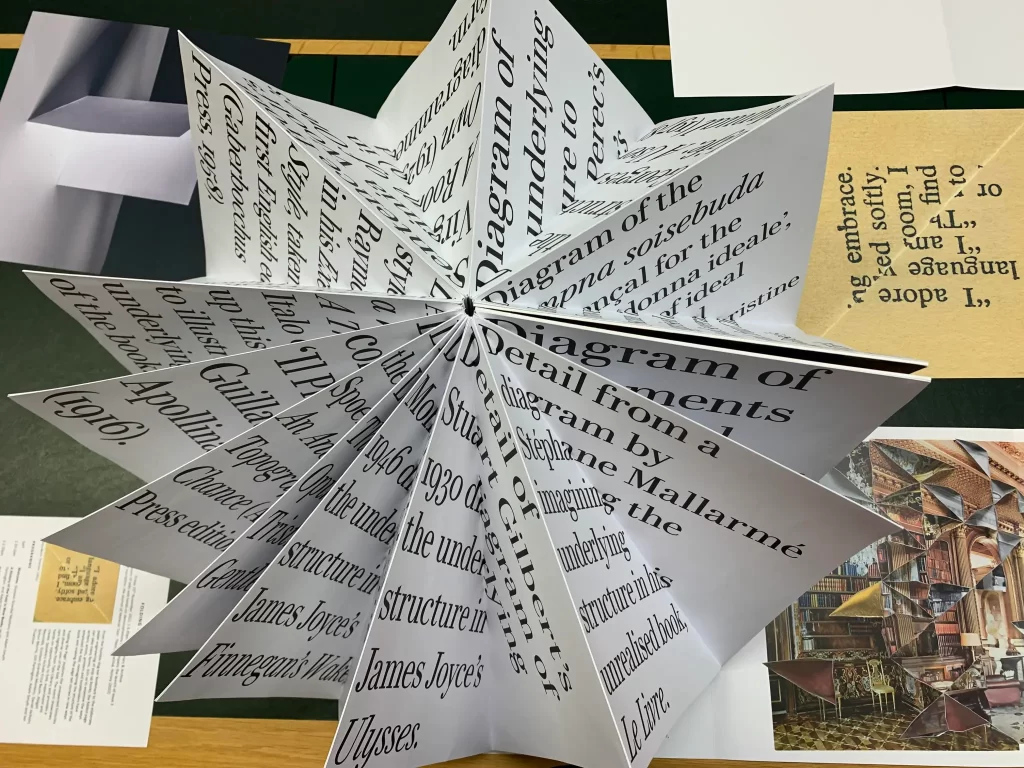
It was amazing to see how much folding contributed to the entire feel of the issue, how it contributed to the materiality of the text, content and images.
The fold that captured my attention the most was the one used for the journal:
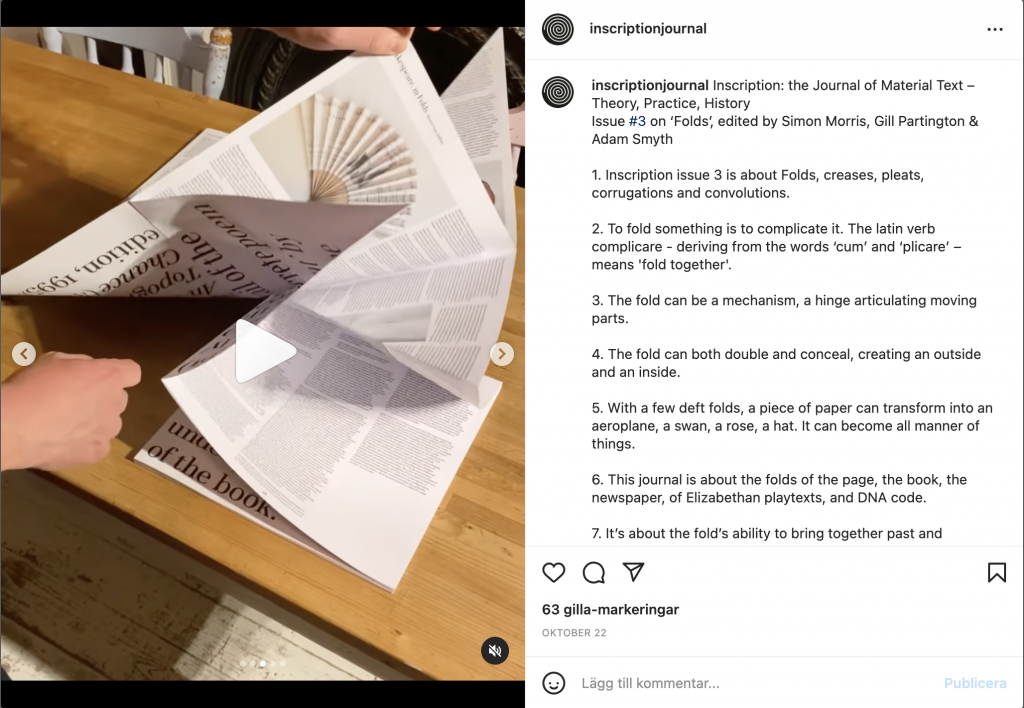
However, the instructions for this fold was nowhere to be found. I had to figure it out myself, I started out with small prototypes and watched the video from inscription journal’s instagram a couple of times and then:
It was not too complex and I looked into making another fold that attached to the first one. I thought this could be a nice attribution and a break from the format sequence that was otherwise quite regulated. I thought Inscription journal had noted something in their instagram post that was a lovely description of a fold: “To fold something is to complicate it”. To some extent that was what I wanted to do, or maybe rather make something more complex.
How and what to write
I am considering writing my texts for each artefact similar to a research article. I think it can be a good idea for me to outline my work in a clear academic writing structure. Especially the longer texts.
I am considering working with 4 different kinds of ‘publications’:
- Introduction to and contextualisation of the project
- Key concepts.
- Artefacts.
- Conclusion–the answer to the overarching research question.
This is the structure I have come up with for the written text on the artefacts, it is a nod to the structure of research article, but adapted for shorter texts.
Introduction
Background for specific artifact — what kind of artifact it is, year, creator, etc. Why that particular one, in which context–temporal, cultural, etc. Establish the prerequisites for the artifact, how did it look before, where in the development does this happen? What were the influences for this?
Key concepts
what is the artefact
what are meaning making processes
what are ideological constructs
research question (adapt it for each artefact)
Method
How, why, what. in which way in this particular analysis.
Analysis & result
create a framework for analysis
connect to present-day
Conclusion
Clarify the results from the analysis
What is the ‘lens’? Reconnect to introduction.
Remember-no new arguments here.
Reflections after discussion with Dr Robyn Cook
I had arranged a meeting with Dr Robyn Cook for a discussion of my PhD proposal. She said that it was very well written, that the proposal is really exciting and that my research is at the forefront of debate. However, our discussion was centered around how I could narrow down my research to look at one specific artefact and still include other things, but hitch my research around one artefact. She told me that I should consider focusing solely on typography since typography is so quintessentially graphic design “typography is so quintessentially graphic design and also language”.
Since my master project is a pilot study of my intended phd, some of her viewpoints were extremely valuable for the shaping of this project. We discussed how this project could be a prelude to a future PhD and she provided some really great insight, understood me, my areas of interest and met me with such positivity and encouragement.
That meeting was very much what I needed right now. I have had an extreme low in this project and the last weeks have been an anxious weighing between keep going, or just check out with a PGDip. But that would also feel like a kind of failure. Thanks to the kindness of Dr Cook, I got some new energy and I will try and push on.
Reflection after feedback from Céline Strolz
The written feedback from Celine on my first draft for the critical report confirmed some of the issues raised in the meeting with Dr Cook. It also provided some practical steps to better narrow down and clearly define my project and the concepts I am working with.
Some specific notes for consideration:
- Some of the terminology remains too broad and vague. It could be beneficial to clarify your own definition of the following: « early modern period », « reveal » and « meaning-making process »
Céline suggests keeping a dictionary, which is a great idea. I have noted also for the sake of the project, an addition in the material that can clarify key concepts. For example, meaning-making process is an established term in semiotics, and my target audience is multimodal semiotician researchers and I have to, in that context, define what I mean with that term. But maybe also for someone who is not included in this target audience? I think it will be important for me to be inclusive, to open up my material for others. - Currently you mention « Western » (global scale) and then « Europe » (local scale, as in the context of cultural understandings, the West is not only Europe). Which is conflicting.
Regarding this I will simply just refer to Europe. I think this interchangeability in referring to these concepts comes from me looking at Early modern Europe from the perspective of the birth of Western ideologies. - You specify an audience within IMS Centre at Linnaeus University in Sweden (micro-level local). It could be beneficial to clarify with intentionality what area you are exploring exactly.
I think the area is rather within discipline than geographically. Maybe that can be further enhanced through a target audience that reaches several Multimodal Research Centres across Europe. - Consideration for the selected artefact (What methodology is applied to make the selection?)
This is something I will have to be clear about, I am primarily looking at artefacts that are somehow the materialisation of ideologies, the most common one being humanism. - Consideration for how you will be testing at practical phase (Will you follow a sort of « protocol » you create for yourself? In an almost forensic way, so that the test is always done the same way)
This will most likely depend on the artefact I will work with.
Reflections
I am considering focusing only on type and maybe specifically the birth of Roman type. That could allow me to hitch the project around that specific area and look at case studies/artefacts that embody ideologies.
Working with this focus would allow me to chose artefacts from the perspective of their significance to development in typography in relation to ideologies. This is something I feel fairly comfortable in doing. I feel like I have known this all along I have just been eager to include more, take a bigger grip at visual communication but I think it is time to realise that is simply not possibly at this time. Typography is at the core of graphic design and it is also the visual representation of language.
I am considering to implement the ‘refracted lens’ in the existing material and let the user be able to engage in that, and to alternate that material somehow. Or maybe the user could be lead to a web for example.
Reflections on possible artefacts
The question is, where do I begin? But I think I will include these example. An appropriate start –>middle ages (Carolingian minuscule)–>renaissance (S&P)-and the final form (Jenson)
Maybe a ‘bundle’ or call for oral culture is something to be considered? What if the link out to something user generated is something that encourages oral culture?