I had a tutorial with Ben as I have been having a hard time imagining my work taking form. The panel review have made me reflect a bit on what would be an appropriate primary and secondary target audience.
Ben said it is definitely a good time to work out who this audience is and what I want to get out the project personally. For me, that has always been clear and the problem is rather my perception of the course’s expectations on my project.
Ben said I should consider what are I am going to do with the designed output. How can it reach the target audience, are they used to engage in print based formats, where are they, conferences for example. How can you take that research and mold it into other ways and let it live as an object in itself?
Ben said something like the artifact would be a bit of research itself and would engage with broader publics.
I need to figure out the context where the target audience move, these are probably likely conferences and journals. I have been looking at a conference held by UCL https://internationalconferencemultimodality11.wordpress.com/
Ben said this will be an artifact that sits beyond the academic journal as a designed object–has a life of its own. It is a designed object not just an academic journal and that I should think about how it can be distributed.
Conclusion and similar projects
My idea is aimed at the target audience as a playful offer to enter the visual part of the theoretical research. It can serve as a research kit for a target audience that normally only does theoretical research, as a way to deepen the connection between the written and the visual within that field.
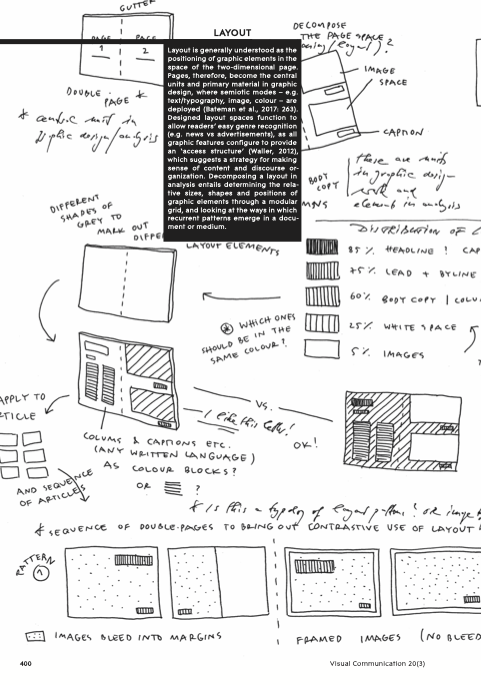
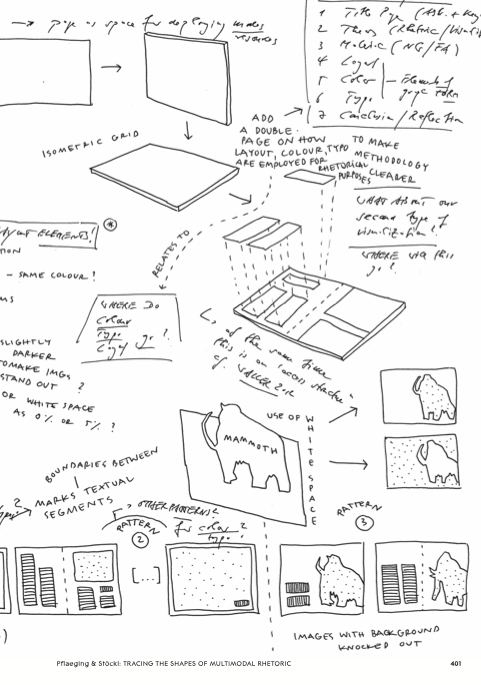
I was thinking about a visual essay I have (that I have printed to read this week) “Tracing The Shapes of Multimodal Rhetoric: Showing the Epistemic Powers of Visualization” by Jana Pflaeging and Hartmut Stöckl. It extends the written research with visual examples, and that is how I wish my visual material could take form, yet a bit less ‘serious’. Which is important to me, the written research will be quite serious and the purpose of the visual components is to blow life into this research. Make it more accessible, and open up for other directions, refract the ‘old’ perception.

Klingspor
I found Klingspor Type Archive and thought they presented their material in such an inviting way. This got me thinking more about how to display the material of the bundle and how to work visually with components inside the bundle. To break up letterforms and pieces of layout and make it come to life through that.
Klingspor presented their material in a range of accessible ways, this really opens up the research. To fragmentise the visual outputs and create a range of entry points to the core of the project.
https://www.klingspor-type-archive.de/archive
Poem Editions
Since a lot of my research comes from the work of ANRT and Jérôme Knebusch, Poem editions is a natural source of inspiration. It is an independent publisher directed by Knebusch with a lot of participation from students, researchers etc, at ANRT.
They are great at making the research available, for example through exhibitions, but they also work with books, typefaces, pamphlets, post cards, posters, art work and more.
https://www.poem-editions.com/

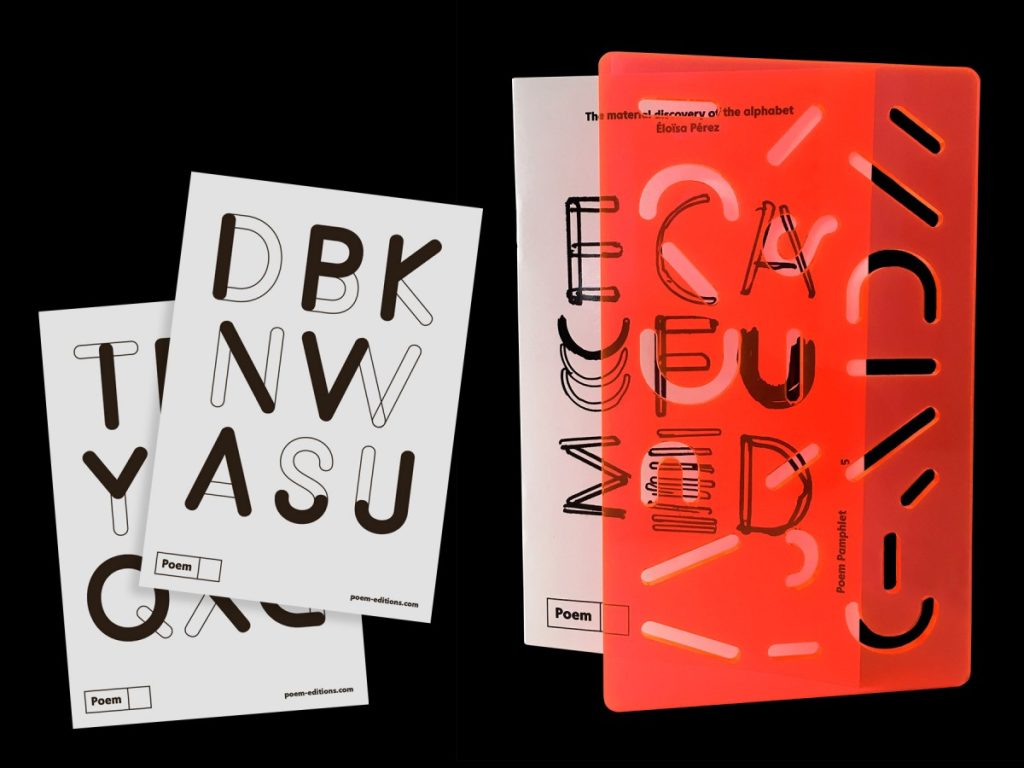
“Éloïsa Pérez’s essay discusses examples from the early 19th century until today. It is structured in three parts: constructing (the letter), guiding (the movement through trajectory and tracing) and composing (the word). The pamphlet is accompanied by the edition of an exclusive capital lettering template and two postcards. Edited by Alice Savoie and Jérôme Knebusch in the Poem Pamphlet series. Translated into English by Nigel Briggs.”
I have seen some of Éloïsa Pérez’s other work, I think she is currently undertaking a PhD and producing a lot of interesting research. She is very good at taking the research and putting it at the literal hands of people (sometimes children). I think that is admirable, to be able to create that kind of interaction between the research, people and then I would guess the people’s interaction with the practical outcome of the research goes back into the research for another cycle.