Here is a compilation of notes and reflections from last weeks Panel review.
Susan Gibb’s recommended I watch BBC’s The Secret History of Writing, and I started watching it. I do enjoy these documentaries and everything I can soak up in book history. I have also studied some of this in Book History, so I recognise some things. However, something I realised watching, that I have never thought of before, was about the complexity around how knowledge is stored in oral cultures. I have studied some of the techniques of preserving knowledge in oral cultures (for examle mnemonics).
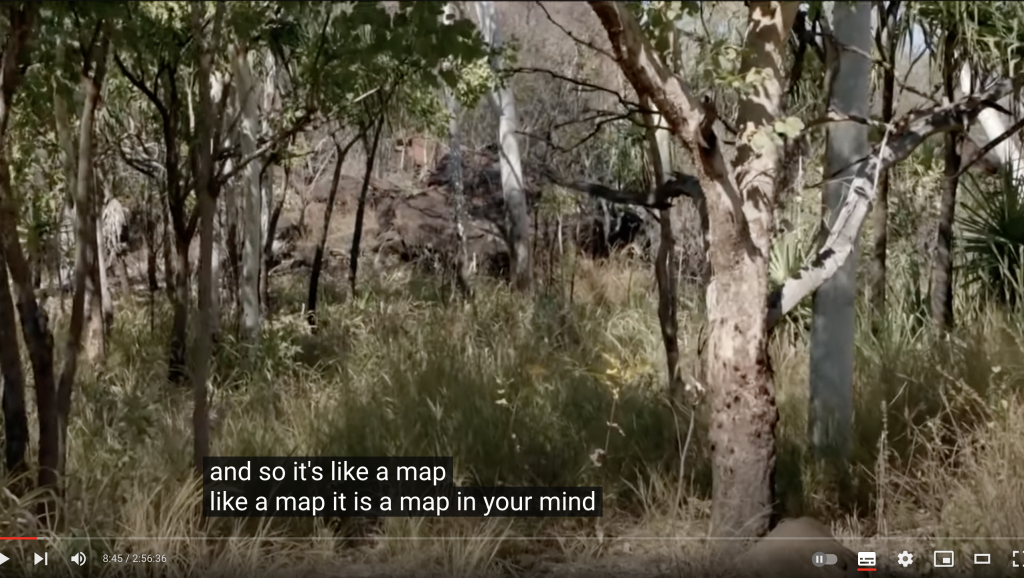
But when watching an interview in this documentary with an indigenous man in Australia, he talks about a song that has been passed on through generations. A song line trail (?) That song names sites, plants, trees, everything in the surroundings. The interviewer then says “And so it’s like a map” and he responds “It is a map–in your mind, but all links up” This means… that they are basically building memory palace’s through songs? This was far more complex than I could have imagined. But when reflecting a bit on it, it seems quite logical. This method of loci could possibly be defined as a mnemonic, it was just that the knowledge was so tied to spatial relationships that made me think of a memory palace. The fact that I am calling it a memory palace is also a problematic approach of me, to try and fit something complex into a Western narrative, just so that I can comprehend it. There is probably lots of research on this. I know oral cultures was/are complex and advanced, but it was still a moment of realisation for me. I have not read Walter J Ong in maybe 2-3 years, maybe its time again.
Susan Gibb talked about how emoticons are a new form of language which is not alphabetic and how that may contribute to shifting in language, especially in china as it is, according to Gibb, changing how people are learning language based on western technology.
She also said: “detailed scope of your project is really exciting” which was great to hear.
She further asked how I see this research unfolding in space to make it public?
This is a discussion that I will develop further down in this post.
Céline mentioned how there is a current hyper awareness of the classification i typography, that is also highly questioned. She mentioned for example the categorisation of latin vs non-latin and concludes that this makes my research relevant.
Céline also said that the fact that I am presenting this research and drawing historical background, already helps question whether it is relevant or not. She said that making these connections and bringing that to a public audience, is in itself raising questions. Which felt quite reassuring to hear. Sometimes I feel like the second part of this project is simply an alibi because I believe that is what this course really wants in a way. But this remark shows that the first part is indeed relevant then.
Céline mentioned Philippe ram, history of architecture and how it relates to how humans were constructed. This sounded like a typical approach of the studia humanitatis which is very much relevant to my project.
Natural History of Architecture, Philipp Rahm. “It was an exhibition, that turn into a book. Basically just by presenting his research in a public space, he is putting these questions out their (an exhibition space, in this case it was at the Pavillon de l’Arsenal in Paris which is a large and very well visited space)”
Susan Gibb continued discussing this public approach and said:
“There are ways to make this public to a general public that would have a really great impact leads to them to second part—how do you actually engage a broader public in this research and the meaning of it to then ask relevant contemporary questions.”
She thought of exhibitions and the range of interesting things that can be unfolded in an exhibition and how I can then also explore how it speaks to technology. She also mentions workshops.
Céline said I can make it into a little exhibition or a little book just find a way to make the research available in a public way. To find a form, an accessible form.
Ben mentioned relational aesthetics, Nicolas Bourriaud.
Susan Gibb said when working with language–why it is important to look at the general public and how relationship with literacy have and still is including and excluding within the space of writing. “Don’t leave that research in a rarefied space to reestablish that relation”.
Reflections
Susan Gibb brought up emoticons and a brief discussion on images as language occured. This took my mind to a project on digital semiotics by Carla Gannis, where she interpreted Hieronymus Bosch’s “Garden of Earthly Delights” using only emojis. That project stems from theory, semiotics, yet has a fun outcome. I think this is something I am worried about, that I won’t be able to make something thats ‘enojyable’ I guess. Gannis says that this project “mash up popular historic and contemporary sign systems” and “Remixing Bosch’s garden with the contemporary language of emoji is alternately parodic and critical. At times my reflections are on the human tendencies, ideologies, or societal constructions that have remained unchanged for centuries, while at other times my mashups speak to the radical paradigm shifts that have occurred as a result of technology and cultural revolutions.”
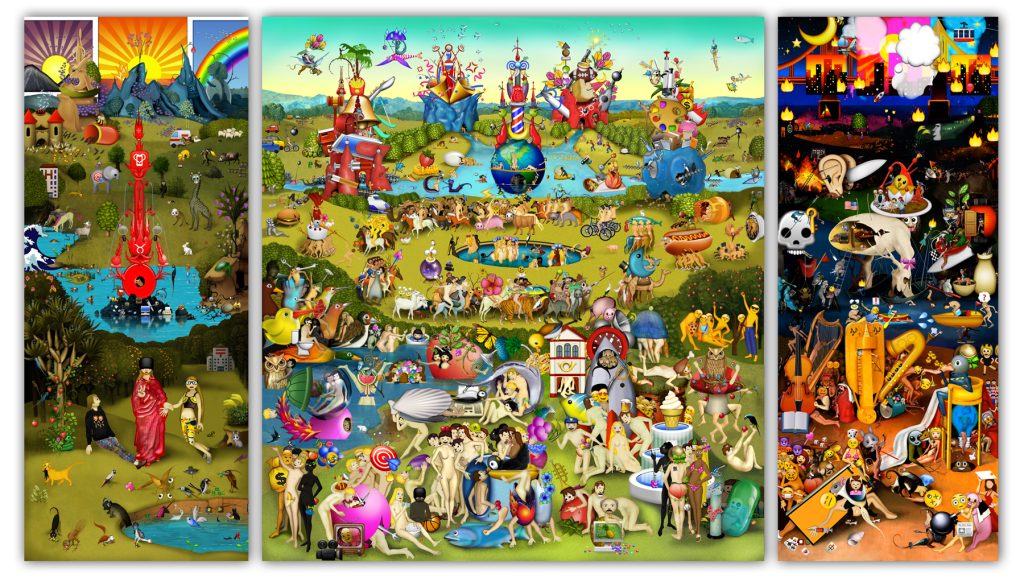
The overarching suggestion for this review was that I should consider how I can make this research accessible. This is actually quite a delicate matter to me. I fully understand the position of not just reiterating the very power asymmetry you are questioning. I do agree, to some extent.
However, I have a hard time seeing why I would make this available to a broader public. The premises of this project is directly aimed at a very specific target audience within social semiotic research. It is, in part, about language and the formation of letterforms. But it is even more an exploration of the premises of a research field that is quite distinct. I also struggle a lot with making things and expecting that others would want to take part of it? I find it hard to explain this without going into a discussion on how I view my own existence as parasital (in a completely non-dark way), but just that sense of entitlement that comes with creating and even more so: showing, is a conflicting thing for me. I do understand how that is inevitable in a situation like this, but it might explain why I sometimes try and find less public routes. However, Susan Gibb’s comment on how leaving research in rarefied space may cause the very exclusion my project also aims to overcome, is something I need to consider.
For the development of this project I will have to solidly establish why the work is taking the form it does and to that particular audience.