Education is still very much based on vertical organisation, built on hierarchy and top down perspectives as discussed in last weeks podcast for promoting greater community cohesion. I wanted to look closer at that and see if there is a way to redistribute some of the existing tools for interaction between Falmouth students and create a more horizontal system.
This week I am investigating the possibilities for a collaborative tool based on listening for design process. I have been reading Linje Manyoza on Pedagogy of Listening and was inspired by that.
Some notes from that reading:
Manyoza writes about how listening can be used to seek out those with inferior status and are subordinate to other marginalized individuals and people and that this can be a deliberate process. This could possibly translate into smaller contexts and not just be about shedding light on people with inferior status, but working on the same premises could possibly help create a more equal platform. Freire on his end, writes about listening as a form of tolerance and how experts often believe their voice is “divine” and to be listened too.
I have been reading some, not much, Freire, before and it is interesting how he views pedagogy as a way to open up the relationship between student and educator. He talks about a pedagogy where the educator does not impose their world view on students, but rather validate knowledge processes, stay humble and use dialoge to open up about our own methods and practices.
“Listening is not naivety, it is a celebration of recognition that other human beings are rational, intelligent and competent to contribute to the dialogues and discourses that we engage in. As such, considering the position of others is an act of faith in that it presents others with an opportunity to question our ideas and the process we have the opportunity to correct errors and weaknesses in our arguments”. Manyozo 2017.
I think it might be good to know that Manyozo is discussing development and communication with communities when working and theorizing on development, but I do think these thoughts apply well to our context as well. He writes for example that listening can be less about taking individual voices into consideration and more about building a spirit of community-ness. (Building on the pod I did last week, where I talked about Community Cohesion.)
Rhizome
I looked at Frauke’s webinar on Friday morning and was intrigued by the concept of Rhizome (from the book A Thousand Plateaus by Félix Guattari and Gilles Deleuze). I felt it connects to my approach in many of my projects. I did some research and it felt like a really good route to go down on for this project. I think it might actually be useful in my phd proposal as well.
“A rhizome, on the other hand, can be seen as “endlessly created connections between semiotic links, power structures and circumstances concerning art, science and social movements”. Rather than turning history and culture into a story, the rhizome presents history and culture as a map or broad spectrum of attractions and influences without a specific starting point or birth, for “a rhizome has no beginning and no end; it is always in the middle, between things, present, intermezzo. ” —Swedish Wikipedia.
First thoughts on idea
The presentation of the challenge considered Falmouth as a possible starting point for this idea, mentioning the fact that we are a global cohort etc
I was thinking if it would be possible to create something where there is a shift from the designer and where I could put culture at the center instead. Maybe create a place where students would be building their processes and it could encourage participatory research, discussions and inspiration.
I thought of the journal, ideas wall, the group crits, are.na but also TikTok. Could it be like an app where projects could be expanded like a rhizome, with stitches/collaborations/layers across the course or maybe beyond that? Like a design process TikTok where the process of a project grows organically
Every student would have their own profile with their projects, and the projects would be specified/categorized after disciplines and interests. It would then be based on the algorithm that separates TikTok from other social media, namely that you do not follow friends in the same way, but you are rather presented to content that matches your interests.
It could be a digital tool that opens up student’s processes organically over Falmouth Flexible, and allows for cross-courses interference. As if you were to scroll a FYP, but for design/illustration/creative writing/etc. And that you could help build on that project through imagery/commentary/etc. So you basically browse projects/processes based on your interests and when opening them up they expand with other students’ contributions so that you can navigate further from that. So if someone took a photo of an extract from Arturo Escobar and put on another student’s process, I would click that and end up on their profile, see their projects but also collaborations and contributions. My interaction with profiles and projects like that would also add to my algorithm and put more projects of that kind or within that discipline on my FYP. Sort of if the research journal, crits and ideas wall was made into a more accessible hybrid where basically anyone could participate in your process and you would primarily navigate and engage in projects of your interests. It would be possible to add video/text/audio/images to the projects.
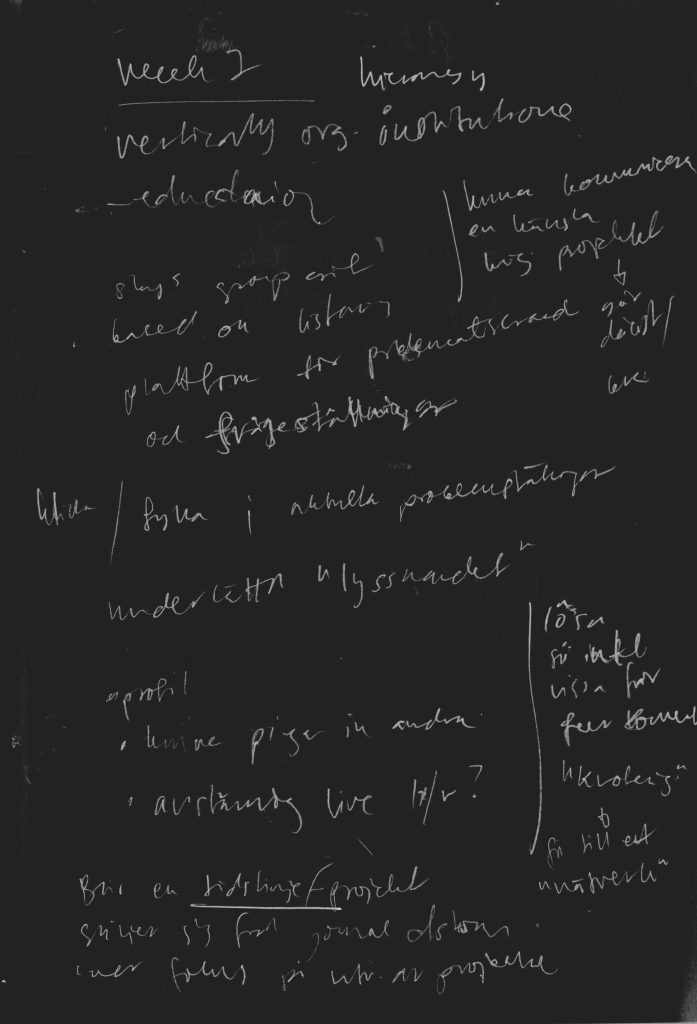
This week challenge presented Falmouth as a possible starting point, mentioning the fact that we are a global cohort. A few ideas were considered and how they could relate to Promoting greater community cohesion.
One idea concerned a space that encourage participatory research, discussions and inspiration, a space where students build their processes together.
I wanted to investigate a space where the creator of a project is no longer at the center of a process but rather culture.
Problems and needs
A while back Susanna sent an email out to students, asking for input on matters that concerns making meaningful connections online. I actually answered some of them in a document (that I forgot to post). They came in handy as a starting point for this
project, though.
From this email I could define there are a few problems with promoting cross cultural dialouge and how to share and learn with empathy and respect.
How can we best understand your needs? How can we promote cross cultural dialogue sharing and learning with empathy and respect? How can we better understand your personal narratives?
The course could better seize the opportunity of viewing the students as the great range of assets they are. Utilising the knowledge and assets of this culturally rich group could deepen the discourse on graphic design from an actual global perspective. But that might require a small shift in the structure of the pedagogy, and it might demand to open up more and put more faith in the students where a space for this discourse to develop is not only provided but facilitated.
For example there could be arrangements of participatory learning experiences that can be facilitated either by a tutor or assigned group of students. There could be curated discussion groups, where, say 3-5 students present/talk about their perspective on a current subject/theme/project. Themes can range from small practical aspects of working with graphic design to overarching concepts. This can open up connections between
cultural interpretations.
On that same notion, I believe that some webinars can be transformed into participatory practices, where lectures can transcend into facilitated discussion on the topic. These discussions can have a defined end goal such as a »checklist for feedback« or »critical question form for students working with speculative projects« etc.
Any ideas regarding cross cultural sharing and etiquette. Any experiences of language/ cultural difference positive or negative and your thoughts on this.
This is an interesting topic as when I started this course I came from studying in a very typical Swedish context where discussion is at the center of the academic work. This sometimes resulted in discussions where the respectful questioning of each other’s research and reflection was building on each other. But I have a strong perception of discussion of that kind being regarded as uncomfortable in this context, like there is a small fear of disagreement and confrontation. While I believe some of these discussions, uncomfortable or not, are valuable in order to gain a better understanding and develop the discourse of our discipline and our own work practice.
Possible approaches
Pedagogy of listening
As mentioned in my response to Susanna’s email a shift of pedagogy could be a possible solution to promote cross cultural dialogue.
Manyozo (2017) writes about how listening can be used to seek out those with inferior status and are subordinate to other marginalized individuals and people and that this can be a deliberate process. Something that could possibly translate into smaller contexts and not just be about shedding light on people with inferior status, but working on the same premises could possibly help ^
create a more equal platform.
Manyozo is discussing development and communication with communities in the context of working and theorising on development. However, I do think these thoughts apply to this context as well. He writes for example that listening can be less about taking individual voices into consideration and more about building a spirit of community-ness.
»Listening is not naivety, it is a celebration of recognition that other human beings are rational, intelligent and competent to contribute to the dialogues and discourses that we engage in. As such, considering the position of others is an act of faith in that it presents others with an opportunity to question our ideas and the process we have the opportunity to correct errors and weaknesses in our arguments.« Manyozo 2017.
Manyozo 2017.
Rhizome
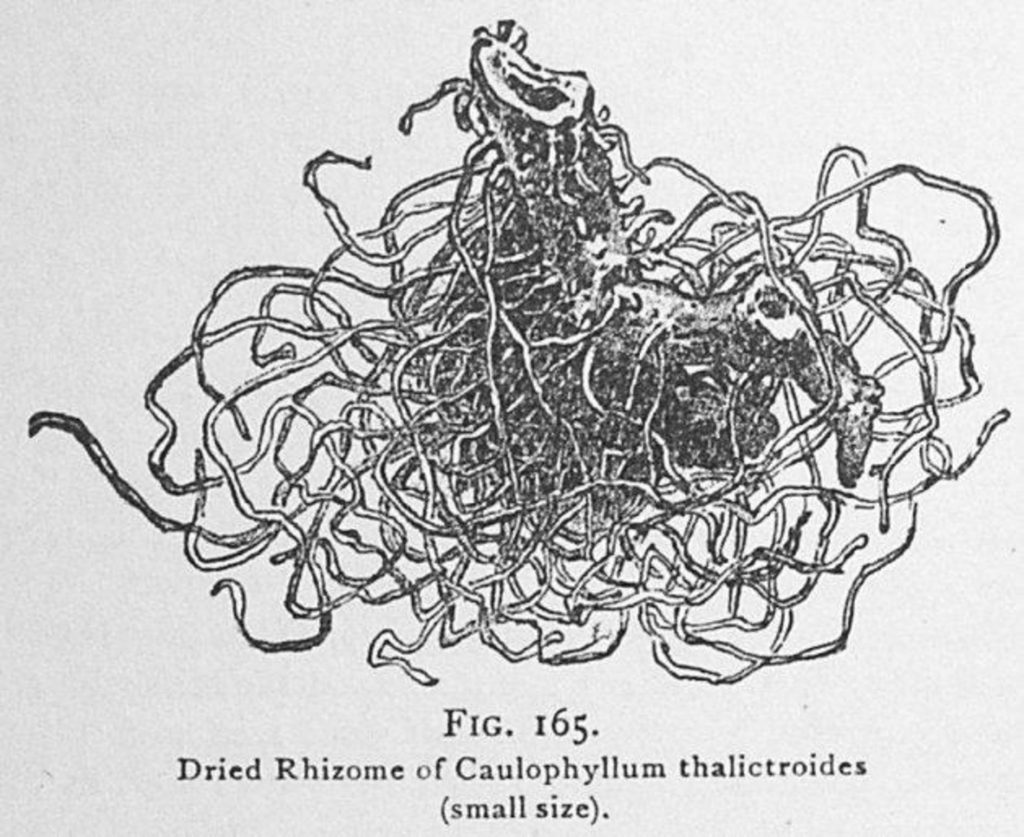
Frauke Stegmann (2022) brought up the concept of Rhizome (Félix Guattari and Gilles Deleuze) during a webinar. A Rhizome contains endlessly created connections without any specific starting or end points. This concept relates to many of the themes and approaches in my research on other projects.
Could the solution possibly echo the rhizome as concept? Can the solution create a shift from the first plane of interaction as explained by Deleuze and Guattari (2005) is in vertical form, a hierarchihal structure of order and to the second plane, of consistency, that has a more horisontal nature. In what ways can the solution allow for a multitude of connections across all Falmouth students’ processes? In what ways can the solution create layers of meaning, that can relate to what Deleuze and Guattari (2005) refers to as dimensions of the plane of consistency?
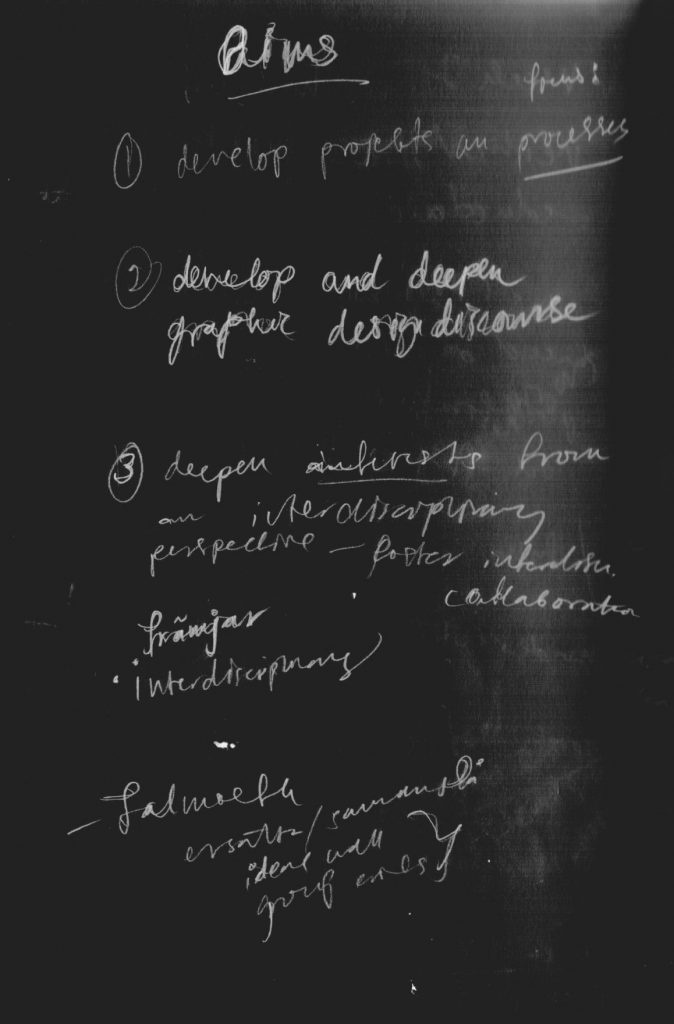
Aims
What could this contribute to?
- Develop projects with focus on processes.
- Develop and deepen design and creative discourse.
- Encourage a deepening of meaning-making activities across Falmouth Flexible.
- Foster interdisciplinary interaction and collaboration.
Maybe there could be a purpose to add possibilities for the person who owns the project to ask specific questions? And formulate specific problems to make the listening easier.
Workshop challenge
References
DELUEZE, Gilles & Felix Guattari. 2005. A Thousand Plateaus. London: University of Minnesota Press.
MANYOZO, Linje. 2017. Communicating Development with Communities. Routledge.
STEGMANN, Frauke. 2022. ‘Collaboration, Cooperation, Trans- Interdisciplinary.’ [lecture]. GDE730 for MA Graphic Design. Falmouth: Falmouth University, 7 July 2022.